

N.Y. family seeks answers for rare chromosome disorder
Machias, N.Y. ? Four-year-old Dalton Eisenhardt and his 2-year-old brother, Wyatt, don’t protest or complain about the machines that hold onto them with tubes and cords during every moment of their lives. Despite the tracheotomies, the feeding tubes and ever-present nurses, the boys smile.
It is harder for those who love them.
The young brothers are fighting a rare and puzzling chromosome disorder, and doctors in Buffalo, 45 miles north, have been unable to find anyone anywhere with the same condition. They cannot tell the Eisenhardts what might come next, what toll the disorder ultimately will take.
So far, dozens of hospital stays, surgeries, doctors’ appointments and consultations have produced only more questions. The family hopes that by telling its story, a doctor or other parent will recognize the disorder and tell them what to do.
“We don’t know what to expect,” said the boys’ mother, Vicki Eisenhardt, in the living room where she spends most of her time caring for her two youngest sons while her husband works as a carpenter. A 10-year-old brother, Tyler, is healthy.
“What we know we’ve learned from Dalton,” she said.
The boys have a disorder called unbalanced translocation chromosome 15. Their mother explains the chromosome has an extra piece, a slight defect that affects every organ in the boys’ bodies.
A year ago, doctors gave Dalton six months to live, saying the damage to his lungs was too great.
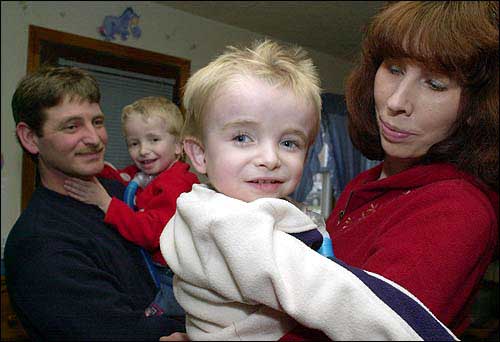
Wyatt Eisenhardt, 2, center, is held by his mother, Vicki, as Dalton, 4, is in the arms of his father, Webb, in the family's living room in Machias, N.Y. The boys have a disorder called unbalanced translocation chromosome 15. Doctors in Buffalo have been unable to find anyone anywhere with the same condition, so they cannot tell the Eisenhardts what to expect.
“Here we are a year later,” his mother said. “Doctors can speculate, but only God knows.”
“We’re not giving up,” added her sister, Kim Claus, one of several nurses who care for the boys full-time.
Dalton has been hospitalized 34 times and undergone 19 surgeries. Worrisome episodes where his skin grows gray and clammy have been increasing. Wyatt spent 100 days in intensive care after his birth. His problems have mirrored his brother’s.
The boys’ beds and shelves full of supplies and equipment have taken over the living room. Nurses, therapists and medical supply deliveries create a revolving door in the family home, and although insurance pays most costs, unseen expenses like the electricity needed to power the machines add up.
But the family does not tell its story for pity — even neighbors in this Cattaraugus County town of 2,400 have been unaware of its plight.
The family keeps to itself, Eisenhardt said, but is at the point where answers are needed.
“When you see your 4-year-old say he hurts, grabbing his chest and so tired he can’t walk across the floor, you want to help,” Eisenhardt said. “You’re going to do anything and everything you can to help him.”