

Activists fight against weight-loss surgery
The newspaper ad inviting fat people to learn about El Camino Hospital’s new weight-loss surgery program offered the opportunity to be not just a thinner person, but a better one.
“It’s not what you have to lose,” the Mountain View, Calif., hospital ad said. “It’s what you have to gain. Pride. Dignity. And Better Health.”
Marilyn Wann, 5-feet-5, 270 pounds and darn proud of it, scanned the ad and fumed: How dare they imply that fat people are not proud, or that dignity is reserved for the thin? Wann threw down the newspaper. Then she smiled and began to e-mail her friends.
At the hospital’s weight-loss surgery workshop in October, Wann and a handful of others blended into the crowd, most of them at least 100 pounds heavier than doctors say they should be. They listened to the surgeons — then Wann blew a whistle.
The infiltrators jumped up, whipped off their clothes and, clad only in bathing suits (Wann in a pink two-piece), danced through the stunned audience with the words “Fat (plus) Pride” and “Fat (plus) Dignity” marked on their stomachs.
The pro-fat parade may not have swayed many at the workshop. But it was an ample demonstration that activists in the fat acceptance movement, as it is sometimes known, were galvanizing against a medical procedure they consider dangerous and demeaning.
Doctors agree that weight-loss, or bariatric, surgeries involve risks, but also argue that for now they are the most effective way for extremely obese people to shed pounds over the long term. The most common type of bariatric surgery is the gastric bypass, in which the stomach is sectioned off, leaving a small pouch at the top that severely limits food intake.
The American Society of Bariatric Surgeons estimates that 103,200 weight-loss surgeries were performed in 2003 and that the number will swell to 144,000 this year.
The surgery is recommended only for people who are at least 100 pounds overweight. Afterward, patients are warned to limit their food intake and to exercise regularly for the rest of their lives.
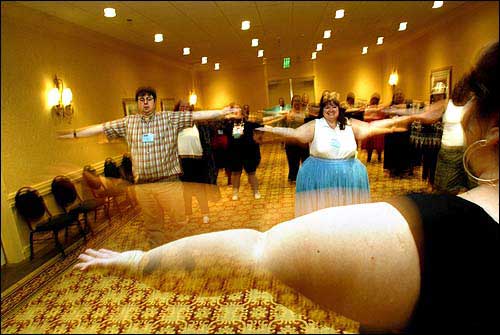
Bill Weitze, left, and Jeri Carmichael participate in a hula dance class at the annual National Association to Advance Fat Acceptance conference last August in Los Angeles. The group opposes the gastric-bypass surgery, in which the stomach is sectioned off.
Many patients are lured to the surgical solution by celebrity success stories, dramatic before-and-after pictures, and promises of small scars — instead of the Frankenstein weals of the 1970s and ’80s. Demand is so great that the wait at some hospitals is a year or more.
Fat-acceptance movement
Against this trend stand a handful of organizations such as the National Association to Advance Fat Acceptance, the Council on Size and Weight Discrimination and the International Society for Size Acceptance. More obscure fat pride groups include SeaFattle in Seattle; Pretty, Porky and Pissed Off in Toronto and the Bod Squad in San Francisco, a radical cheerleading group.
Risks of obesity
The National Institutes of Health, the Centers for Disease Control and Prevention, the U.S. surgeon general, the American Diabetes Association — and, of course, the American Society of Bariatric Surgeons — all maintain that obesity is dangerous.
Numerous studies show that obese people are at high risk for diabetes, hypertension, sleep apnea, some cancers and a range of other life-threatening conditions.
“Someone who is 40 years old and 100 pounds overweight will get diabetes,” said Roland Sturm, a health economist at the Rand Corp. in Santa Monica, Calif. “I know there are people who don’t like it when I say that. I’ve had threats from some of those activists. But it’s the truth.”
But Wann said fat people were put in an impossible position.
“It’s what I call a gun to the head. They tell you that only surgery works, and oh yes, you’ll die if you don’t do something now. But are they crazy? I wouldn’t risk my life to mutilate a perfectly healthy organ for the odds that they give.”
The death rate for weight-loss surgery, quoted by the bariatric surgeons society and some fat activists, is one in 200.