

Bridge project ends at site where Indian remains found
Seattle ? State officials Tuesday ended all work at a bridge construction yard after sinking $58 million into a project halted by the ongoing discovery of hundreds of Indian remains and ancient artifacts.
The Washington Transportation Department said it would look for another place to build replacement sections for a large portion of the Hood Canal floating bridge.
The project to widen and improve the bridge, the major link between the Olympic Peninsula and the Puget Sound region, was initially estimated at $283 million, but now with the forced move could cost “substantially” more, the department said.
“We do not come to this conclusion lightly,” a statement from the department said. “Despite the mutual good faith efforts of both WSDOT and the Lower Elwha Klallam Tribe to develop an acceptable place to allow the fabrication of work to continue … we have jointly determined that it is not possible.”
The 22.5-acre site in Port Angeles on the Olympic Peninsula was to have served as a dry dock where sections for the bridge were to have been built before being towed 50 miles to the bridge.
The Transportation Department said the state couldn’t find a way to get the bridge rebuilt in a reasonable time and without huge overruns while respecting the needs of the Lower Elwha Klallam Tribe to find and honor its ancestors.
“I think the sheer scale and uncertainty of what is yet in the ground pointed us in the direction of leaving,” agency spokeswoman Linda Mullen said.
Tribal chairwoman Frances Charles, who had written department officials earlier this month demanding that work stop at the site, said the tribe was relieved its ancestors could now be left in peace.
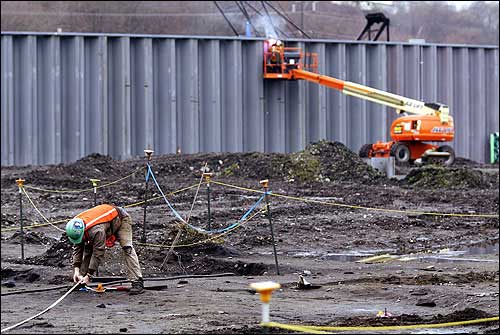
Even as an archaeologist measures an artifact recovery site, at left, workers weld on a wall segment in this photo taken Thursday at a site in Port Angeles, Wash. The Washington State Department of Transportation had planned to use the site to build new pontoons and anchors for the aging Hood Canal floating bridge. The state said Tuesday that it had ended all work at the site, where hundreds of Indian remains have been discovered, and that the state will look for a new site for making the bridge parts.
“The right decision was made,” she said.
The tribe prefers to leave the burial site as undisturbed as possible.
In August 2003, the first human bone fragment was found during excavation; work shut down six days later. Since then, artifacts and hundreds of full or partial remains have been found at the site where the Klallam village of Tse-whit-zen stood for 1,700 years before it was leveled in the 1920s to make way for a sawmill.
“The bridge rehabilitation will, in the end, take more time and cost more dollars — perhaps substantially more dollars — than we originally expected,” the statement said. “We have, however, no real choice.”