

Returning soldiers retool as repairmen
Des Moines, Iowa ? Former soldiers, including those returning from Iraq or Afghanistan with disabilities, are finding that their military background can help them get jobs in civilian companies.
Maytag Corp., for example, has an aggressive recruiting program for turning recently discharged soldiers into repair technicians. Home Depot Inc. began Operation Career Front and Toyota North America started its Hire A Hero program in the past few years.
Companies say it’s a win for them because they get high-quality workers.
“They have great discipline. They have great technical skills. They understand how to follow orders and follow procedures,” said Art Learmonth, president of Maytag Services.
Many soldiers say it was an easy transition from war machine to washing machine.
“It’s a great big sense of accomplishment every time you do a job,” said Steve Ware, 43, of San Diego, who joined Maytag after 20 years in the Navy as an aircraft technician. “I had the same feeling in the military.”
About 5,000 companies are registered with the Marine For Life program, which helps soldiers find work in civilian businesses after leaving the service, said Maj. Carolyn Dysart, spokeswoman for the program.
Almost 40 companies have signed on to a separate program that hires disabled veterans, many offering jobs to soldiers coming home from Iraq with a disability. The list includes Colonial Life Insurance, and the corporate office of Time Warner Cable, a unit of Time Warner Inc.
“They are saying, ‘We’d love to hire disabled veterans; we’re here for you; send them our way,'” Dysart said.
Lt. Col. John Tansill, spokesman for Employer Support of the National Guard and Reserve, said the military liked the fact that companies were seeking out soldiers.
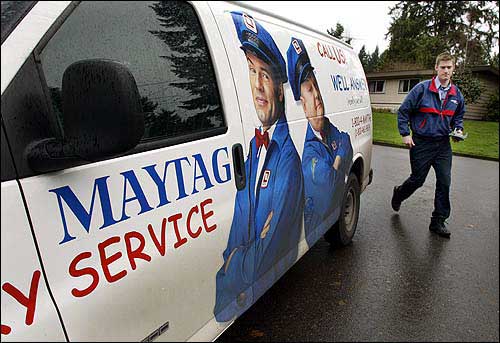
Paul Adams, a Maytag repairman who was recruited by the company after he served four years in the Army, makes a service call in Bellevue, Wash. Former soldiers returning from Iraq and Afghanistan are finding that their military backgrounds have value at Maytag Corp., which has an aggressive recruiting program to turn recently discharged soldiers into repair technicians.
“It’s telling the military, ‘We like the product that you produce,'” he said.
Paul Adams, 25, of Spokane, Wash., said he was nervous about his job prospects after four years in the Army. A Maytag recruiter contacted him after seeing Adams’ resume posted on Monster.com Web site.
Adams soon joined about 14 other men with military backgrounds in Galesburg, Ill., for the first Maytag “boot camp” — four weeks of classroom training in appliance repair, followed by four to six weeks in the field with a mentor.
“Everybody was sort of impressed and felt fortunate to have an opportunity like that,” Adams said.
Maytag launched its repair business — serving all makes and models of appliances — last year, and since then has expanded into more than 50 markets representing 64 percent of U.S. households. The repair service is expected to reach about 71 percent of households in 2005.
Sears, Roebuck & Co. is largest single company provider of home appliance repair, followed by General Electric Co. and Maytag. But with more than 75 percent of the market served by independent appliance dealers and repair service operators — whose numbers are declining — Maytag sees plenty of room for growth.
“One of the problems that we have is, as my folks say, ‘Mamas don’t raise their kids to grow up to be service technicians,’ ” Learmonth said. “We’ve developed a solution to that problem. We hire young folks coming right out of the service. Many of them coming right back from Iraq.”
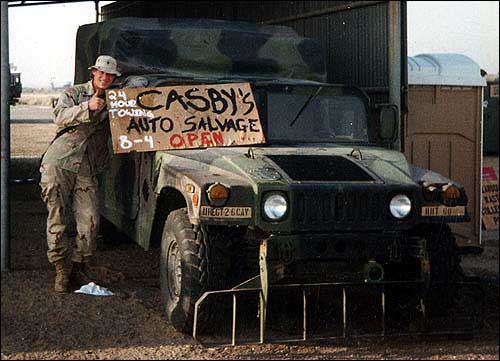
Paul Adams is shown in a light moment at the Kuwaiti Air Base, where he was working in January 2003 as a wheeled-vehicle mechanic in the U.S. Army.
Learning fast
Ware, the former aircraft technician, said the boot camp eased many former soldiers’ concerns because of the similarity to military training.
“They teach you a lot of stuff quickly,” he said. “In the military we’re accustomed to that,” he said.
He’s been in the field repairing appliances since June and said that the job was what he’d hoped to find as a civilian.
“I look forward to going out to the truck to see what I’m going to be doing today,” he said.
For Adams, the customer service part of the job initially was overwhelming, but he’s become more comfortable with the personal interaction with customers.
He gets some mild ribbing from customers that he doesn’t look like Ol’ Lonely — the repairman portrayed in company advertising and on the side of the repair vans.
“People talk about it,” he said. “I’m younger. They say my picture should be on the side of the van.”
National

Feds won’t seek death penalty in plea deal with man accused of killing top Minnesota Democrat

NASA unveils astronauts to test tech for future moon landing
Social Security’ fund faces shortfall one year earlier than expected
WASHINGTON (AP) — Social Security 's retirement trust fund is projected to face a funding shortfall in 2032, a ...

House passes $70B bill to fund immigration enforcement for 3 years

Texas teen convicted of murder for stabbing another athlete at track meet
Multiple people shot near a festival in Ohio, authorities say
Multiple people were shot Saturday near a community festival in Toledo, Ohio, and police said a search for the ...