

How merger could affect consumers
The announcement Wednesday that Sprint Corp. and Nextel Communications Inc. plan to combine raises more questions than it answers about the effects of the deal.
What will the new company look like? How many people will be laid off? Will customers be better off?
As it appears now, here are some known or potential impacts of the deal:
Q. When will the two companies actually combine?
A. Sprint and Nextel are projecting that it’ll happen in the second quarter of 2005. They don’t expect it to take longer than the eight months needed to gain approval of Cingular Wireless’ purchase of AT&T Wireless. It really depends on when and if the Federal Communications Commission, state utility regulators and the antitrust division of the U.S. Justice Department allow it to happen.
Q. Does this mean employee layoffs for Nextel and Sprint?
A. There will be job cuts, but nobody is saying how many. As Sprint Chairman and Chief Executive Gary D. Forsee pointed out: “Certainly, as we rationalize our organization, there will be head-count impacts.” As a baseline, consider this: Cingular is talking about eliminating 10 percent of the 68,000 premerger jobs over the next year.
Q. What area faces the most job cuts?
A. One analyst predicts that the Kansas City area, home to about 17,000 Sprint employees, will be particularly targeted.
Q. What will be the impact of the merger on Sprint’s and Nextel’s customers?
A. Until regulators bless the deal, not much. It’ll be well into 2005 before that might happen. But Nextel customers gradually will be moved over to Sprint’s network beginning in 2006, using a technology called CDMA, and away from the iDEN technology that Nextel currently uses.
Q. Will the customer notice the changeover?
A. Sprint and Nextel customers should get at least as much as they would have gotten if the merger never happened. Both companies had planned to invest billions of dollars in their separate networks. They want to upgrade to a high-speed wireless system on which customers can download data, games, e-mail, music and other services. Now, the combined companies only have to do it once, not twice.
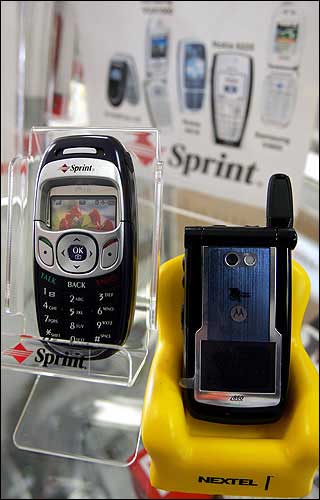
The Sprint LGPM325, left, and the Nextel Motorola i860 phones line shelves at People's Wireless in San Francisco. The 5 billion combination of Sprint Corp. and Nextel Communications Inc. could challenge Cingular Wireless and Verizon Wireless for supremacy in a competitive business.
Q. What happens to Nextel’s push-to-talk technology?
A. It’ll stay. It’s one of the main selling points to Nextel’s typical customer, the small- to medium-size business that wants a walkie-talkie type service. Sprint Nextel plans to keep using both Nextel’s network, which is better at push-to-talk, and Sprint’s current network, which is better at data capability, until some point where everybody migrates to an upgraded system.
Q. How will customers use both the Nextel push-to-talk capability and the data features on Sprint?
A. Motorola Inc. plans to build a phone that can handle both the Nextel and Sprint systems beginning in 2006. Motorola will also support the iDEN network, built on its technology.
Q. Will the merger benefit Sprint customers?
A. The main plus will be the addition of push-to-talk capabilities for those who want it. Sprint has had a push-to-talk offering, but it hasn’t been nearly as successful as Nextel’s. It’s also possible that the combined company could build out its higher-speed wireless system faster than Sprint or Nextel alone would have done.
Q. Who will the winners be among the companies that sell products and services to Nextel and Sprint?
A. We’ll have to wait because a lot of decisions still have to be made. Certainly, any company that provides hardware and software for CDMA technology is a winner, and those ranks include Nortel Networks Corp., Lucent Technologies Inc. and their suppliers. Qualcomm Inc., which pioneered CDMA, is sitting pretty.
Q. What about Motorola?

 6News video: Phone giants announce deal
 Sprint to buy Nextel for $35 billion
A. Motorola was supposed to be a loser because it supplied the iDEN system and phones to Nextel, but Motorola has also been a big provider of CDMA products. The merger gives Motorola a significant inroad into Sprint, and the iDEN technology probably provided little profit to Motorola.
Q. How about the losers?
A. As Nextel prepared for its own system upgrade, it has been weighing the merits of CDMA vs. technology sold by Flarion Technologies Inc., a New Jersey company. With the merged company using CDMA, Flarion appears to be out. And while Motorola will sell CDMA products to Sprint Nextel, we don’t know if those CDMA sales will outweigh their lost sales of iDEN products.
Q. How much will the combined companies save?
A. Company executives estimate Sprint Nextel will enjoy “synergies” of more than $12 billion by eliminating cell sites and switches, putting Nextel on Sprint’s next-generation wireless technology, building one network rather than two and combining administrative forces, customer care, sales and other functions.
Sources: The companies, analysts Will Power of Robert Baird in Dallas and Albert Lin of American Technology Research, Dallas Morning News research