

Communication breakdown figured in Pat Tillman’s death
Newspaper publishes account of friendly-fire horror in Afghanistan
Washington ? The last minutes of Pat Tillman’s life were a horror of misdirected machine-gun fire and signals to firing colleagues that were misunderstood as hostile acts, according to an account published Sunday of the death of the NFL-player-turned-soldier.
It took the Army a month to change the record to show that Tillman, the Arizona Cardinals defensive back who gave up a $3.6 million contract to become an Army Ranger, was killed last April not by Afghan guerrillas but by his Ranger colleagues.
Even then, the statement by Lt. Gen. Philip R. Kensinger Jr., head of the Army’s Special Operations Command, gave few specifics of the corporal’s death and implied that he was trying to suppress enemy fire when he “probably died as a result of friendly fire.”
The Washington Post on Sunday, in the first article of a two-part series, published what it described as the first full telling of how and why Tillman died. The newspaper said it had access to “dozens of witness statements, e-mails, investigation findings, logbooks, maps and photographs.”
‘Fearless on the field’
Tillman’s decision to trade the celebrity and luxury of pro football for a grunt’s life at the bottom of the Ranger chain of command shocked many people, but not those who felt they knew him best.
“There was so much more to him than anyone will ever know,” reflected Denver Broncos quarterback Jake Plummer, a teammate at Arizona State University and on the Cardinals, speaking at a memorial service last May. Tillman was “fearless on the field, reckless, tough,” he said.
“I play football. It just seems so unimportant compared to everything that has taken place,” Tillman told NFL Films after the 9-11 attacks. His grandfather had been at Pearl Harbor. “A lot of my family has gone and fought wars, and I really haven’t done a damn thing.”
He was close to his younger brother Kevin; they finished each other’s sentences, friends recounted. They enlisted in the U.S. Army Rangers together in spring 2002. Less than a year later, they shipped out to Iraq.
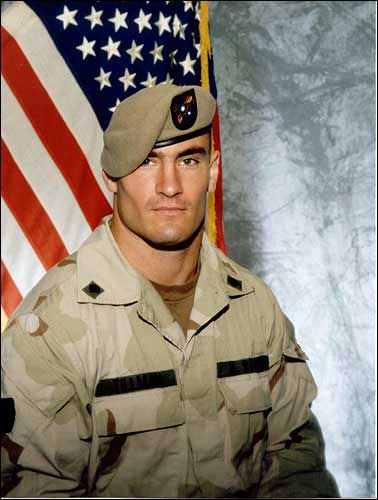
Former Arizona Cardinal Pat Tillman, shown in this June 2003 photo, was killed in Afghanistan after losing communication with other U.S. soldiers. Tillman, who served with the Army Rangers, was 27.
Pat Tillman accepted his ordinary status in the military and rarely talked about himself. One night he confided to Steve White , a Navy SEAL on the same mission, that he had just turned down an NFL team’s attempt to sign him to a huge contract and free him from his Army service early.
“I’m going to finish what I started,” Tillman said, as White recalled at the May memorial. The next morning Tillman returned to duty and was ordered to cut “about an acre of grass by some 19-year-old kid.”
Special investigation
A series of mishaps and missteps began the chain of events that resulted in Tillman’s death in eastern Afghanistan, the Washington Post reported. A Humvee broke down, which led to the splitting up of his platoon.
The segment of the platoon with Tillman, Serial One, passed through a canyon and was near its north rim. The other segment, Serial Two, changed its plans because of poor roads and followed the same route into the canyon. It came under fire from Afghan Taliban fighters.
Men in Serial One heard an explosion that preceded the attack, and Tillman and two other fire team leaders were ordered to head toward the attackers, the Post said. The canyon’s walls prevented them from radioing their positions to their colleagues, just as Serial Two had not radioed its change in plans.
Tillman’s group moved toward the north-south ridge to face the canyon, and Tillman took another Ranger and an Afghan ally down the slope.
“As they pulled alongside the ridge, the gunners poured an undisciplined barrage of hundreds of rounds into the area Tillman and other members of Serial One had taken up positions,” the Post said Army investigators concluded. It said the gunner handling the platoon’s only .50-caliber machine gun fired every round he had.
The first to die was the Afghan, whom the Americans in the canyon mistook for a Taliban fighter.
Slain by friendly fire
Under fire, Tillman and almost a dozen others on the ridge “shouted, they waved their arms, and they screamed some more,” the Post said.
“Then Tillman ‘came up with the idea to let a smoke grenade go.’ As its thick smoke unfurled, ‘This stopped the friendly contact for a few moments,”‘ a Ranger was quoted as saying.
Assuming the friendly fire had stopped, the Ranger said, he and his comrades emerged and talked with each other, the Post reported.
“Suddenly, he saw the attacking Humvee move into ‘a better position to fire on us.’ He heard a new machine gun burst and hit the ground, praying, as Pat Tillman fell,” the Post reported.
The Ranger said Tillman had repeatedly screamed out his name and shouted for the shooting to stop, the Post said. He and others waved their arms, only attracting more fire. Tillman was shot repeatedly by rifles, finally succumbing to the machine gun.
Early in the firing, the Post said, the driver of one of the Serial Two vehicles pulled out of the canyon and recognized the parked U.S. Army vehicles in front of him. “The driver shouted twice: ‘We have friendlies on top!’ … Then he yelled several more times to cease fire, he recalled.
“‘No one heard me.”‘
Brother on site
Kevin Tillman declined to be interviewed for these stories and was not asked by Ranger investigators to provide sworn statements. But according to other statements and sources familiar with the investigation, Kevin was initially asked to take up guard duty on the outskirts of the shooting scene.
He learned that his brother was dead only when a platoon mate mentioned it to him casually, according to these sources.
Army commanders hurriedly awarded Pat Tillman a posthumous Silver Star for valor and released a nine-paragraph account of his heroism that made no mention of fratricide.