

March honors victims of Bhopal industrial disaster
Bhopal, India ? Twenty years after a cloud of deadly gas savaged this central Indian city, about 1,500 survivors and their supporters marched to the gates of a former Union Carbide plant on Friday, demanding justice for those still suffering the effects of the world’s worst industrial disaster.
Another group of protesters staged a mock funeral procession for Warren Anderson, who was Union Carbide’s chief executive at the time. A straw-filled effigy of Anderson was later set aflame.
“Never again should a Bhopal happen anywhere in the world,” Balkrishna Namdev, a rights advocate, told the crowd outside the abandoned pesticide plant in Bhopal. “However long it takes, our struggles to get justice will go on.”
The factory leaked 40 tons of poisonous gas on Dec. 3, 1984, killing at least 10,000 people and affecting more than 555,000 others, although the exact number of victims has never been clear. Many died over the years due to gas-related illnesses, like lung cancer, kidney failure and liver disease.
“Don’t forget the victims of the genocide in Bhopal!” and “Death to Dow!” the protesters shouted. Their banners carried similar slogans, accusing Union Carbide and Dow Chemical Co. of inadequate compensation and medical help for the victims. Michigan-based Dow Chemical bought Union Carbide Corp. in 2001.
Union Carbide paid $470 million in compensation under a settlement with India’s government in 1989. But much of the money has been tied up by bureaucratic and legal issues and many people have received little or nothing.
“For the last 20 years I’ve been visiting the hospital and government offices, begging for compensation to take care of my two children,” said Leelaben Aherwar, whose baby girl survived the gas leak but began showing signs of mental and physical disabilities soon after.
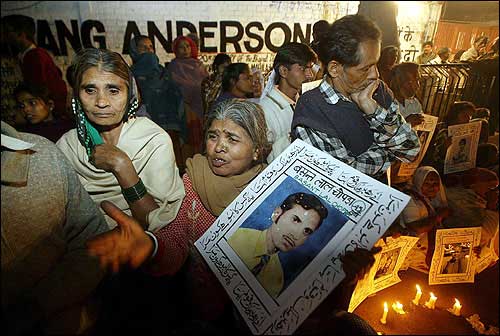
Survivor Bagwanti Devi talks to fellow survivors during a candlelight vigil on the 20th anniversary of the poisonous gas leak disaster in Bhopal, India. She holds a photograph of her husband, Basant Lal Chopra, who died after the accident at the former Union Carbide plant.
Her son, born a few years later, suffers from similar problems. “The answer is always the same: ‘The court will make a decision.’ I don’t know what court is this that cannot see our suffering,” she said Friday.
So far, she has received about $360.
The protesters also called on Dow Chemical to clean up the plant site, where rusted pipes and pesticide storage tanks have collapsed or ruptured in the years since.
Organizers had predicted a turnout of several thousand people, but only about 1,500 came, said Hari Narayan, a local police officer. Few people believed the rally would accomplish much.