

N.Y. bids for 2012 Games
International hot spots seek hosting rights
Athens ? Reasons not to be host to an Olympics seemed to surround finalists for the 2012 games Sunday.
In Athens, costs have spun out of control. Security officers with automatic weapons line the streets of this ancient city. Empty restaurants and, especially outside the capital, empty hotels, reflect what actually has become a 50 percent decrease in Greek tourism this summer.
Even so, Sunday’s list of contending cities might have been the most impressive lineup for any competition during these games: New York, London, Paris, Moscow and Madrid — a collection of the world’s most glamorous spots, each with half an hour to make their case to international media.
And so during four hours of presentations, the cities showed off artists’ renderings of Olympic competitions under the shadows of the Eiffel Tower, Big Ben, Statue of Liberty.
But if the Olympics now need the world’s greatest cities, do those cities actually need the Olympics? Phillipe Baudillon, head of the Paris, effort put it most directly.
“The Olympics represent a much-needed injection of modernity and energy into Paris,” he said. “Paris does need the games.”
Panos Livadas, general secretary for Greek’s General Secretariat of Information, said he believed no matter how bad it might look for Greece right now, these games are successful. The costs of the games here were high, spiraling from an expected $5 billion to more than $7 billion and potentially more than $10 billion by the time all the bills are tallied.
But Livadas said that most of the money was spent on items Athens needed, with or without the Olympics. The city now has a subway, a desperate need, and a ring road, another necessity.
Similar sentiments were at the heart of all the bids explained Sunday (though Moscow representatives said they’ve got the facilities in place to stage the games tomorrow, if needed). Sometimes the sentiments were similar: Both New York and London prepared presentations where they called themselves “Olympic village” because of their diverse populations.
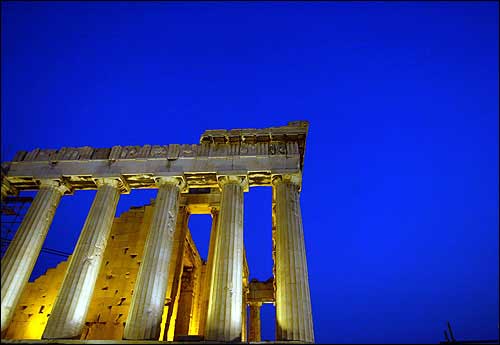
The ancient Parthenon temple on the Acropolis Hill is lit after Thursday's Olympic flame-lighting ceremony. As the Games continued in Athens, international hot spots like New York, London and Paris presented bids Sunday to be host to the 2012 Games.
All noted the love of their citizens for sport, and all noted how the games would be a great excuse to spruce up the place.
The most expansive plan came from London, which in addition to turning a neglected Victorian-era industrial area into a park plans to spend $30 billion on public transportation improvements.
“We need it anyway,” London Mayor Ken Livingstone said. “With the idea of a bid, I was able to get the money without much hassle, however.”
N.Y. moving past 9-11
Likewise, New York wants to use the games to rebuild an image. Daniel Doctoroff is a deputy mayor of New York and leads the city’s Olympic bid effort. He believes that New York, traditionally, has been known around the world as the city where dreams come true. That hasn’t been the case since 9-11, however. An image of hope has been replaced by one of despair.
While Doctoroff doesn’t believe this new image reflects reality, he acknowledges the power of the images of the terror attacks that show up regularly on televisions worldwide.
“We’re at a unique moment in New York City’s history,” he said in an interview. “Post 9-11, there’s a spirit to remake the city, make it better than ever.”
That’s not necessarily in a construction sense, however. New York has most of the buildings and infrastructure needed right now. It plans some new construction. Like London, it plans to make over an unused factory and shipyard district across the water from the United Nations.
They’re also planning to build a main Olympic Stadium that also would be the new home of the New York Jets football team. And then there’s the creation of a regatta center out of what was described as two polluted lakes.
Security advantage
But Doctoroff notes that New York has 60 percent of the needed facilities ready right now, and, through remodeling, could quickly get another 20 percent ready. And, like the other cities, New York wouldn’t have the security issues faced in Athens. “We have 36,000 police officers,” he said, noting that in the months after 9-11 they provided security for a World Series, the New York Marathon, the United Nations General Assembly, the Macy’s Parade, “And much more, and that was while the fires were still burning at ground zero.”