

Sprint adds phone service partner
Cable companies given opportunity to enter market
Kansas City, Mo. ? Sprint Corp. today announced its second Internet phone service partner, this time trying to establish a niche with small- and medium-sized cable companies.
USA Companies, a Kearney, Neb., cable provider with 63,000 customers in Nebraska, California and Montana, said it hoped to have the service in subscribers’ homes by early next year.
Terms of the five-year deal were not disclosed.
In December, Time Warner Cable, with 11 million customers, announced it would use both Sprint and MCI Inc. to provide phone service across the country through technology the industry calls voice-over-Internet protocol.
More cable companies want to get into phone service as a way to remain competitive, especially as satellite companies and local telephone carriers are taking away customers by offering video and high-speed Internet capability.
“It’s a free-for-all land grab in the home telephone market, and Sprint is just providing the ammo,” said Greg Gorbatenko, a telecommunications analyst for Marquis Investment Research.
In voice-over-Internet, customers make calls with their regular phones, but the calls travel as packets of data over the cable going into their home or business, as opposed to the traditional telephone line.
Once the data reaches a switching station, the call is transferred to Sprint’s phone network and into the format that reaches most phone users.
The biggest problem facing small carriers, such as USA Companies, is that they lack the money to build a telephone network.
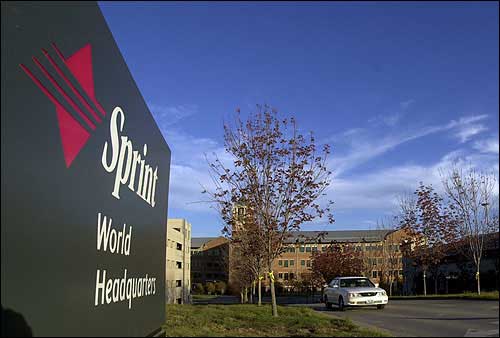
A motorist leaves the Sprint Corp. world headquarters campus in Overland Park, shown in this October 2001 file photo. Sprint is reaching out to small- to medium-sized cable companies to form partnerships that enable them to offer telephone service.
Sprint, however, already owns its own local and long distance service networks, much of which lies dormant in the evenings when businesses are closed but many residential customers want to make calls.
“Prior to the last year, getting into voice was considered capital-intensive and out of reach for small- and medium-level operators,” said Mark Bishop, senior vice president of the 1,100-member National Cable Television Cooperative. “But the price has come down, and companies like Sprint have come into the market to offer the ‘back office’ infrastructure to make voice possible.”
Ralph Hodge, Sprint’s senior vice president of cable solutions, said Sprint had spent the last year talking with cable companies about providing voice-over-Internet service and said he could announce more partnerships this fall.
“We’re basically telephone service in a box,” Hodge said.
Sprint is not alone in becoming a supplier for cable companies, as carriers like Level 3 also have sold the use of their infrastructure. Verizon Communications and AT&T Corp. are selling Internet phone service directly to the public, an environment Gorbatenko said Sprint should avoid.
“Verizon is getting in the pit and slugging it out,” he said. “Sprint is in the grandstands cheering them on because they’ll sell the Band-Aids when the fight is over.”
Gorbatenko, however, said he wasn’t sold on the idea of targeting smaller cable companies, saying Sprint would get much more mileage from other cable companies like Time Warner.
“I’d say they’re going to get more bang for their buck by tagging big-name clients,” he said. “Rolling up mom and pops can have an economic benefit, but I don’t think getting Joe’s Cable Company will pop the stock at all.”