

Satellite to test Einstein theory
Washington ? An idea conceived when Dwight Eisenhower was president finally soared into orbit Tuesday when NASA launched a satellite designed to test parts of Albert Einstein’s theory of relativity.
It took decades of technological development and funding fights to get the $750 million satellite from the drawing board, where it began in 1959, to the launch pad at Vandenberg Air Force Base in California.
Gravity Probe B finally lifted off Tuesday aboard a Delta 2 rocket, after a much anticipated launch on Monday was scrubbed because of a slight weather problem.
Gravity Probe B is only 21 feet long and a paragon of simplicity in a field where spacecraft are usually crammed with instruments and gadgets. But the four gyroscopes at its core, suspended in a supercold vacuum, will offer scientists’ best opportunity ever to prove — or cast doubt upon — parts of Einstein’s theory.
As the probe orbits 400 miles above Earth’s two magnetic poles, subtle movements of its gyroscopes will measure how space and time are “warped” by the orbit of the planet.
Gravity Probe B will test two parts of what Einstein theorized in 1916: first, that the mass of an object, such as the Earth, causes space to curve around it; second, that its rotation slowly drags space and time with it, a theoretical effect that has never been seen.
Scientists have compared the first effect to that of a marble denting a rubber sheet, then twisting and gathering the sheet around it as it rotates.
Once Gravity Probe B spends two months acclimating itself to space, scientists want to take measurements for a full year, as the Earth makes an orbit around the sun, plus another month for some overlap.
It will probably take another year to fully analyze the results.
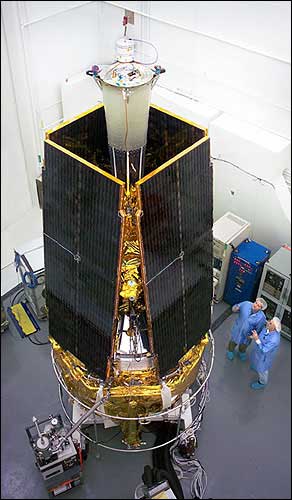
Gravity Probe B is designed to test two of Albert Einstein's fundamental predictions about the universe. NASA launched the satellite Tuesday from Vandenberg Air Force Base in California.
The satellite will be aligned with a distant star using a tracking telescope. Then, scientists will look for drift in the alignment of the spinning fused-quartz gyroscopes. If there is movement, they are expecting it to be minuscule–but even that will bolster Einstein’s hypotheses.
“We expect to see the curvature of space and the rotation of space caused by the gravity of the Earth to be in accordance with this theory,” said Gaylord Green, the program manager for the satellite at Stanford University, which is the probe’s prime contractor for NASA. “If it is not, then that’s a significant violation and has us looking at the universe in a different way. …”
Green said the team will have the best test of Einstein’s ideas ever obtained after only one month of data.
The importance of that information cannot be overstated, he said: “As mankind goes forth to understand where it came from … this is a fundamental measurement that we have to make.”