Spiritual health
Medical experts explore religion's
Dr. Harvey Elder and a colleague at Loma Linda University Medical Center in Loma Linda, Calif., were puzzled. They could find no medical reason for a 37-year-old woman to have asthma so severe that she had suffered two heart attacks.
Elder asked her why she thought she had asthma.
“Because I had an abortion,” the woman replied. Shocked by the implied belief of divine punishment, Elder blurted out, “My God’s not like that.”
A few hours later, the woman stopped wheezing.
In that moment 30 years ago, Elder began realizing the importance of religion in health care and how ill-prepared he was to deal with it.
“I became increasingly aware that there is within a patient a whole domain I had not learned about in medical school,” he said. “I have seen so many patients where spiritual issues, guilt, loneliness are the root controls of behavior.”
Since the late 1980s, the role of religion in a patient’s health has been the subject of numerous studies. The National Institutes of Health has awarded millions to research religion, spirituality and meditation in relation to health.
That comes as Americans are turning to religion in the face of rampant materialism, said William Cutter, director of the Kalsman Institute on Judaism and Health at Hebrew Union College in Los Angeles.
“We have a bit of a spiritual climate now,” Cutter said by phone.
Researchers find that people who attend religious services regularly tend to live longer, recover faster from serious illness and require fewer hospitalizations.
Although studies of prayer have been controversial, one report in 2001 found that heart patients who were prayed for or those who participated in stress-reduction, imagery or touch therapy suffered 25 percent fewer complications.

The hands of Dr. Mustafa Kuko are clasped against his robes during the Eid al-Adha service of the Mosque of Riverside, Calif.
Religious belief can cause negative outcomes as well. A 2001 study at Duke University Medical Center found that patients who believe that God punishes them or that they have been abandoned by God or their church were more likely to die within two years after being discharged from the hospital.
Although most spirituality research has focused on Christian patients, this appears to be similar for people of other faiths, said Dr. Harold Koenig, a psychiatrist at Duke University Medical Center in Durham, N.C., and a leading researcher of the relation between religion and health.
“People with devout religious faith who are active in a religious community appear to be generally healthier and happier,” Koenig wrote in an e-mail.
Frequency of church attendance seems to significantly affect people’s health, said Jim Walters, professor of Christian ethics at Loma Linda University.
Walters is completing a pilot study of Adventist religious beliefs and practices, and their effect on health.
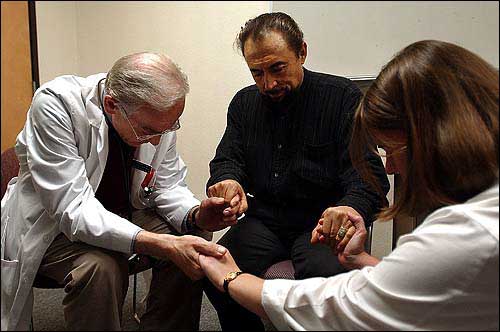
Above: Dr. Harvey Elder, left, patient Alvaro Casas, 63, and medical student Annelise Olsen pray after Cacas' medical appointment at the San Bernardino Department of Public Health Clinic.
“Church attendance is an indicator of a whole lifestyle,” he said. “Churchgoers tend to be less sexually promiscuous, eat better and drink less.
“There is an ethos conducive to health (that) you don’t find in other groups.”
Four out of five Americans believe that personal prayer or religious practices can speed recovery, some polls show.
For Muslims, the physical act of lying prostrate to pray improves the flow of oxygen to the brain, said Dr. Mohammad Hossain, a pediatrician in Redlands and Riverside.
“Praying five times a day is like taking medicine five times a day,” he said. “Prayers bring God in the heart. Prayer is nutrition of the mind and helps in healing.”

Left: The men of the congregation kneel during the the Mosque of Riverside's Eid al-Adha service at the Recreation Center at the University of California, Riverside.
Health

ER visits for tick bites on the rise throughout the Midwest
FDA OKs first new sunscreen ingredient in over 25 years
WASHINGTON — Federal health regulators last week signed off on the first new sunscreen ingredient for the U.S. ...
OB-GYN group makes its 1st vaccine recommendations
A prominent OB-GYN group announced vaccine recommendations on Wednesday that differ from what the U.S. ...

How to talk to kids about vaping as fruity flavors make a comeback
Program that helped people with disabilities scrapped again
Margaret Tomlinson has been recovering from a traumatic brain injury for three years. Nearly a year ago, she moved ...