

Rice says U.S. couldn’t stop 9-11 plot
Washington ? National security adviser Condoleezza Rice vigorously defended the Bush administration’s handling of terrorist threats in testimony Thursday before the commission investigating the Sept. 11, 2001, attacks, saying “there was no silver bullet” that could have stopped the plot.
But Rice’s testimony came amid disclosures from the commission that President Bush was warned in a highly classified intelligence briefing five weeks before the attacks that al-Qaida leader Osama bin Laden was intent on striking targets on U.S. soil.
The title of the briefing — “Bin Laden Determined to Strike in the U.S.” — was revealed Thursday, as were some of its contents, including a warning that the FBI had detected domestic activity “consistent with preparation for hijackings.”
The significance of the briefing was the subject of a testy exchange between Rice and a Democrat on the panel, and the hearing ended with commission Chairman Thomas H. Kean, former Republican governor of New Jersey, calling for the full document to be declassified.
“We feel it is important that the American people get a chance to see it,” Kean said. “We are awaiting an answer on our request and hope by next week’s hearing that we might have it.”
The commission is scheduled to hear testimony Tuesday and Wednesday from top law enforcement officials.
Rice did not directly respond, except to say earlier during the hearing that the panel had already been granted “exceptional access” to the document. Later Thursday, administration officials said the document would be declassified at an unspecified time.
Speaking to a nation
The hearing, held in a packed chamber on Capitol Hill, combined history and high political drama. It marked the first time that Rice, one of Bush’s closest advisers, testified publicly about the administration’s counterterrorism efforts before the attacks. It represented Rice’s opportunity to rebut testimony at an earlier hearing during which former White House counterterrorism official Richard Clarke said the Bush administration had largely ignored the terrorist threat during its first eight months in office.
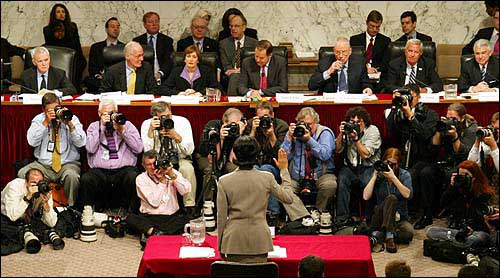
National Security Adviser Condoleezza Rice is sworn in before testifying to the independent commission investigating the Sept. 11 attacks. Rice acknowledged Thursday that President Bush received a CIA briefing five weeks before 9-11 that included, even in its title, details about al-Qaida's desire to strike inside the United States, but she insisted the attacks couldn't have been prevented.
While Rice’s answers were primarily aimed at the 10 members of the bipartisan panel, she also spoke in broad terms to a nation still struggling to come to grips with the attacks, and weighing the administration’s performance in the war on terrorism.
Bush and his wife, Laura, watched Rice’s testimony from their ranch in Crawford, Texas.
Rice sought to portray the White House as engaged and acutely aware of the terrorist threat, but exasperated by the “frustratingly vague” intelligence it was getting on al-Qaida’s intentions, and hampered by bureaucratic and political obstacles that seemed impassable before the attacks awakened America to terrorist dangers.
The most significant new information centered on the classified briefing — known as the president’s daily brief, or “PDB” — that Bush received from the CIA on Aug. 6, 2001.
Although it has been known for some time that Bush received a briefing that day mentioning the possibility that terrorists might seek to hijack aircraft, the title and other details had not been disclosed.
During questioning, Rice said, “I believe the title was ‘Bin Laden Determined to Strike Inside the United States.’ ” A U.S. intelligence official, in an interview with the Los Angeles Times, said the actual title was, “Bin Laden Determined to Strike in U.S.”
Rice’s answer came in response to a pointed round of questioning by Richard Ben-Veniste, a Democrat and former Watergate prosecutor. Ben-Veniste said the commission had until Thursday been denied permission by the White House to disclose so much as the title of the briefing, and the bulk of its contents remain classified. Ben-Veniste went on to say the briefing warned the FBI had detected “a pattern of suspicious activity in the country, up until Aug. 6, consistent with preparation for hijackings.”
Downplaying a briefing
The revelations would seem to contradict long-standing claims by Rice and other Bush administration officials that all of the threat reporting and intelligence information they received during the months before 9-11 pointed exclusively to attacks on overseas targets.
Rice sought to downplay the significance of the briefing, saying it was prepared by the CIA in response to a request by Bush for information on domestic threats, and that much of its contents were “speculative” or old intelligence.
“It was historical information based on old reporting,” Rice said. “There was no new threat information, and it did not, in fact, warn of any coming attacks inside the United States.”
Bush was in Crawford when he received the August 2001 briefing, and did not return to Washington until the end of that month.
Rice also acknowledged Thursday that she had been told by Clarke in early 2001 that al-Qaida had sleeper cells in the United States, but said she could not remember whether she had ever shared this information with Bush.
She dismissed his complaint that his pleas for action were ignored, saying “not once during this period” did Clarke complain to her that federal agencies weren’t responding adequately to the threat warnings preceding the attacks.
| Slade Gorton: We’ve now gone two and a half years and we have not had another incident in the United States even remotely comparable to 9-11.In your view — there have been many such horrific incidents in other parts of the world, from al-Qaida or al-Qaida lookalikes …Have the measures that have been taken here in the United States actually reduced the amount of terrorism?Condoleezza Rice: I believe that we have really hurt the al-Qaida network. We have not destroyed it. And it is clear that it was much more entrenched and had relationships with many more organizations than I think people generally recognize.¢Timothy Roemer: Dr. Rice, you have said in your statement, which I find very interesting: “The terrorists were at war with us, but we were not at war with them. Across several administrations of both parties, the response was insufficient. And tragically, for all the language of war spoken before September 11th, this country simply was not on a war footing.”You’re the national security adviser to the president of the United States. The buck may stop with the president; the buck certainly goes directly through you as the principal adviser to the president on these issues.And it really seems to me that there were failures and mistakes, structural problems, all kinds of issues here leading up to September 11th that could have and should have been done better.Doesn’t that beg that there should have been more accountability? That there should have been a resignation or two? That there should have been you or the president saying to the rest of the administration, somehow, somewhere, that this was not done well enough?Rice: Mr. Roemer, by definition, we didn’t have enough information, we didn’t have enough protection, because the attack happened — by definition. And I think we’ve all asked ourselves, what more could have been done?I will tell you if we had known that an attack was coming against the United States, that an attack was coming against New York and Washington, we would have moved heaven and earth to stop it.¢Roemer: Why don’t you get Dick Clarke to brief the president before 9-11? Here is one of the consummate experts that never has the opportunity to brief the president of the United States on one of the most lethal, dynamic and agile threats to the United States of America.Why don’t you use this asset? Why doesn’t the president ask to meet with Dick Clarke?Rice: … What I wanted Dick Clarke to do was to manage the crisis for us and help us develop a new strategy. And I can guarantee you, when we had that new strategy in place, the president … was going to be in a position to engage it fully. …Dick Clarke — let me just step back for a second and say we had a very — we had a very good relationship.But all that he needed — all that he needed to do was to say, I need time to brief the president on something. But …Roemer: I think he did say that. Dr. Rice, in a private interview to us he said he asked to brief the president …Rice: Well, I have to say — I have to say, Mr. Roemer, to my recollection … Dick Clarke never asked me to brief the president on counterterrorism. … He, to my recollection, never asked. |