

Light-scanning technology may detect dirty hands
Washington ? With just a flicker of blue light, little Johnny’s mother one day may know for sure whether her son washed his hands before dinner.
New light-scanning technology borrowed from the slaughterhouse promises to help hospital workers, restaurant employees — one day, even kids — make sure that hand washing zaps some germs that can carry deadly illnesses.
A device the size of an electric hand dryer detects fecal contamination and pinpoints on a digital display where on a person’s hands more scrubbing is needed.
eMerge Interactive Inc., a struggling technology company in Sebastian, Fla., is hoping to tweak light scanners it already sells to beef plants to detect the same kinds of nasty germs on humans.
The blue-light scanners could dramatically improve hygiene among employees who forget to wash their hands after bathroom breaks. This practice is a leading cause of food poisoning that afflicts tens of millions of Americans every year.
Studies show people typically fail to scrub around fingernails and between fingers adequately. The government recommends people wash their hands for at least 20 seconds; researchers find many people do not even use soap.
“People are not good at hand-washing,” said Janet Anderson, a nutritionist at Utah State University. “We find that unless sinks are very close to where people are handling food, they don’t wash their hands well.”
eMerge, which demonstrated an early prototype for The Associated Press, said its first clean-hand scanners could go on sale as early as year’s end to restaurants, nursing homes, hospitals and day-care centers. Using identification cards, the devices can even record which employees scrubbed acceptably and which ones still have dirty hands.
Jim Mann, executive director of The Handwashing Leadership Forum, called the scanning technology promising but “not a silver bullet” because it cannot detect pathogens such as salmonella or viruses that do not always spread initially in fecal contamination. Salmonella can be present in raw eggs.
Using a specific light wavelength, the scanners cause a fluorescence in even minuscule amounts of fecal contamination that could carry dangerous bacteria like E. coli; it shows up on a built-in display as a bright red spot on a person’s dirty hand.
“Nobody wants to have doo-doo on their burger,” said Jacob Petrich, a biophysical chemist at Iowa State University who invented the meat-scanning technology with two scientists, Thomas A. Casey and Mark A. Rasmussen.
Health
Program that helped people with disabilities scrapped again
Margaret Tomlinson has been recovering from a traumatic brain injury for three years. Nearly a year ago, she moved ...

Excitement builds as LMH Health draws closer to completing Therapy Services renovations
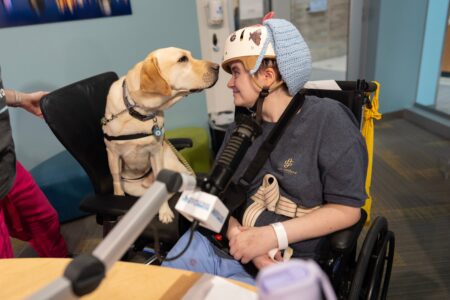
More children’s hospitals turn to furry caregivers to help kids heal
Sometimes ‘baby blues’ is actually something darker
Moments after Jenna Carberg gave birth to her daughter, doctors put the baby on her chest. “I felt a disconnect ...

Moving to music offers all kinds of benefits as you age
Conflicting mamogram advice leads to confusion
WASHINGTON — Deciding when to get routine mammograms is confusing. Some health groups recommend women begin at ...