

Selling history a challenge for Williamsburg
Museum slashes programs in wake of $35 million deficit
Williamsburg, Va. ? Budding 8-year-old history buff Maura Taylor, wearing a Colonial-style dress and bonnet sewed by her mother, stands and stares as Thomas Jefferson discourses eloquently in front of a crowd.
That kind of scene happens often at Colonial Williamsburg, the restored 18th-century capital of Virginia, where costumed workers take visitors back to America’s formative days. It’s just not happening quite as much as it used to.
With declining attendance and a $35 million budget deficit, the nation’s largest living-history museum is laying off nearly 400 of its 3,500 employees and cutting programs.
Officials at the private, nonprofit foundation that operates Colonial Williamsburg blame the weak economy, lingering fears of terrorism since the Sept. 11 attacks, less focus on Colonial history in schools and this year’s rainy weather. And they note other such “heritage” sites also have falling or flat attendance.
Tourism industry observers say Colonial Williamsburg also may be battling the perception that it’s, well, boring, thus losing thrill-seeking potential visitors to livelier entertainment, such as amusement parks.
“All of this is not a picnic,” acknowledged Colin G. Campbell, president of the Colonial Williamsburg Foundation, which receives no regular state or federal funding. But “the process we’re in is not a process in which we’re trying to make sure that this survives. It’s a process to make sure it thrives and is all it can be.”
Attendance had been declining since about 1995, when there were 150,000 more visitors than today, but has fallen more sharply since the Sept. 11 attacks, Campbell said. Ticket sales last year fell to the lowest level in four decades — dropping to 840,000 from 931,000 in 2001 — and Campbell said attendance this year might end up below 800,000.
“I’m surprised that, given the fact that there is sort of a re-examination going on in this country at large about what we’re all about and our role in the world, the messages of places like Colonial Williamsburg and the other historic sites aren’t messages that people are craving to hear,” he said.
An evolving mission
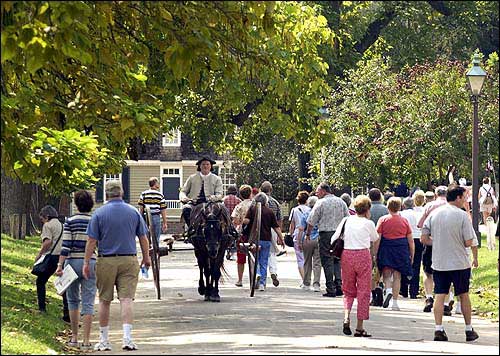
A historical interpreter rides a horse-drawn buggy in the restored area in Williamsburg, Va. With declining attendance and a 5 million budget deficit, the nation's largest living history museum is laying off nearly 400 of its 3,500 employees and cutting programs.
The foundation, which also runs hotels, restaurants, golf courses and merchandising businesses, began cutting costs earlier this year with management layoffs and the closing of its Carter’s Grove plantation for assessment and repairs. Budget expenses have been reduced $10.5 million for 2003, and the foundation’s goal is to balance its budget by 2006.
“Everyone is worried” about their jobs, said Aaron Wolfe, a costumed interpreter at Colonial Williamsburg’s new Great Hopes Plantation, a re-created 18th-century farm where visitors can learn how slaves and their masters lived.
“A lot of employees feel upper management has lost sight of the mission of Colonial Williamsburg,” he said. “The program is here so the future can learn from the past, not to cater to the elite.”
Wolfe cited plans to open a resort spa and center that will offer one-day health evaluations for about $3,000 per customer. Wolfe said he’d rather see Colonial Williamsburg “cut prices and market to a middle class that can come here and have a good time.”
Colonial Williamsburg announced the spa and center this month, just days before revealing that it will lay off 95 employees in its 300-acre Historic Area by Jan. 1 and cut programming in the area by 20 percent next year. The job cuts come on top of 300 layoffs throughout the organization this year.
| WhereColonial Williamsburg is 150 miles south of Washington, D.C., midway between Richmond and Norfolk, on Interstate 64. Take exit 238 and look for green and white signs for the Visitor Center. From there, you can take a shuttle bus or walk to the Historic Area.PriceA one-day general admission ticket is $39 for adults and $19.50 for children 6-14. A “Freedom Pass” good for admission for one year is $49 for adults and $24.50 for children 6-14.HoursColonial Williamsburg is open year-round. Fall hours of operation, through Nov. 23, are 9 a.m. to 5 p.m.ContactFor more information, call (800) HISTORY, or visit www.colonialwilliamsburg.org or www.history.org. |
Campbell said the spa and health center, which will be run by outside investors with Colonial Williamsburg as the landlord, would attract visitors who might otherwise go to resorts elsewhere.
He said the foundation, established in 1926, had always had a resort component to help support the Historic Area, which has 88 original buildings and hundreds of other rebuilt Colonial-style homes, shops and public buildings.
In need of emotion?
John Siddall, a Richmond advertising and public relations executive who has advised tourist destinations, said Colonial Williamsburg’s problem was captured by a scene from the television sitcom “Frasier.”
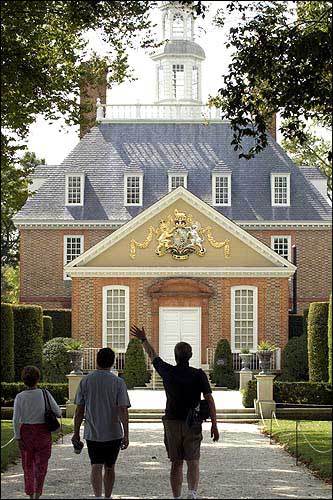
Visitors at Colonial Williamsburg walk in the gardens behind the Governor's Palace. Ticket sales at Colonial Williamsburg last year fell to the lowest level in four decades -- dropping to 840,000 from 931,000 in 2001.
The title character tells a co-worker that he’s taking his son to Colonial Williamsburg on spring break. Appalled that he isn’t taking the boy to Disney World, she asks Frasier what there is to do in Williamsburg. He replies, “You can make butter.” She screams at him, “You’re taking him to Butter World!”
“That’s what’s wrong,” said Siddall. “People think, ‘I should go to Williamsburg,’ rather than ‘I want to go to Williamsburg.'”
Siddall suggested the foundation needed to connect emotionally with visitors, perhaps by bringing in some of America’s greatest storytellers.
“I look at Ellis Island. They made that come to life. You cannot go there without a lump in your throat and a tear in your eye,” Siddall said. “That’s what needs to happen at Williamsburg. You shouldn’t just go there and say, ‘This is interesting.’ You should go there and cry.”
Campbell said Colonial Williamsburg featured fun and educational activities for all ages, “but it’s not clear to me that people understand that as well as they could.”
Colonial Williamsburg isn’t alone.
Mount Vernon, George Washington’s home in northern Virginia, froze hiring and cut expenses after attendance fell 21 percent last year, spokeswoman Stephanie Brown said.