

Liberian war is over — but rebels still armed
Tubmanburg, Liberia ? Machine guns. Rocket launchers. Mortars by the crate. An hour’s drive from the country’s newly peaceful capital, Liberia’s rebels remain locked, loaded and battle-ready at their headquarters in the bush.
In an early, and crucial, challenge to U.N.-sponsored disarmament here, insurgents have tacked a few more demands — more power, more money — onto their Aug. 18 peace deal. And they insist they’ll keep their bargaining chips, their weapons, until the new conditions are met.
“Jungle mortar — yeahhh,” crooned one young rebel, fishing a round out of the back of a pickup truck painted with skull-and-crossbones as a friend rolled a cigar-size joint of marijuana.
With a U.N. convoy rolling through town a few miles away, rebels at their base in northwest Liberia showed off their arsenal. To give it up, rebel leader Sekou Conneh now says, he wants a bigger share of power in Liberia’s new transitional government than agreed to so far.
When he gets that, “I’m going to pack up my guns in our place, so you can come take them,” said Conneh, whose assault on Monrovia helped chase warlord-turned-president Charles Taylor into exile in August.
First, though, Conneh is awaiting the approval of five rebel officials to Cabinet posts as part of the deal for a transitional government, created to guide Liberia until 2005 elections.
And in a demand that’s nowhere in the peace accord, Conneh also wants top positions for rebels in every department of government — including police, immigration and port management.
“As soon as we are fully represented in the government, then we have no reason to keep arms,” the rebel chief said.
Disarmament, due to start in December, stands as the most important next step toward ending 14 years of gun-running and bloodletting here.
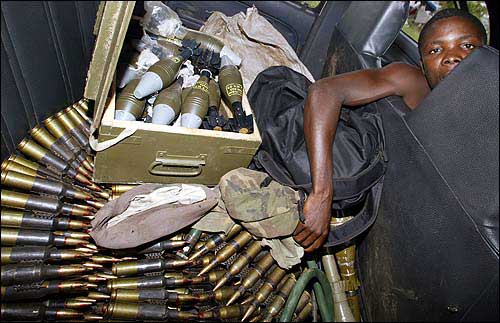
A rebel fighter with the Liberian United for Reconciliation and Democracy displays 60mm mortars and large-calibre ammunition of the type used on the attack on Monrovia recently, at the group's headquarters in Tubmanburg, Liberia. The process of disarmament in the war-ravaged West-African nation is beginning to get under way, but large numbers of weapons remain held by all sides.
In setting new demands, it’s unclear whether rebels are simply angling for any extras before complying with the peace deal — or imposing new conditions that will prove the deal-breaker.
A used-car salesman, Conneh is practiced in driving bargains.
His likeness — in a suit and tie — is painted on billboards all over Tubmanburg, the rebel stronghold 50 miles north of the capital, Monrovia. “The Liberator,” the headline over his image declares.
In his office and throughout his concrete house, his face looks down from clocks and calendars.
Outside, uniformed men sat in the shade as boys in ratty T-shirts and plastic flip-flops stood guard.
“When the big, big people get their offices, I’ll give up my gun,” said 16-year-old Isaac Johnson, with an assault rifle hanging down from his shoulder.
Down the hill, a rebel who called himself Woman Jacket — “I love women,” he explained — guarded a checkpoint with boys in black “Death Squad” T-shirts, all armed.
“I still have my gun, so I can’t say the war is over,” Woman Jacket said.