

Americans, Russian share physics Nobel
Two American citizens and a Russian won the Nobel Prize in physics Tuesday for helping explain some of the strange occurrences that can happen when matter is chilled to extremely low temperatures.
Some of that odd behavior is already employed in MRI body scanners and could someday be harnessed to create high-speed levitating trains.
The Royal Swedish Academy of Sciences cited Alexei A. Abrikosov, 75, and Vitaly L. Ginzburg, 87, for their theories about superconductivity, the ability of some materials to conduct electricity without resistance.
And Anthony J. Leggett, 65, was honored for explaining one kind of superfluidity, a peculiar behavior shown by extremely cold liquid helium.
Abrikosov is a Russian and American citizen based at the Argonne National Laboratory in Illinois; Ginzburg is a Russian based at the P.N. Lebedev Physical Institute in Moscow; and Leggett is a British and American citizen based at the University of Illinois at Urbana-Champaign.
They will split $1.3 million in prize money. The phenomena they studied are linked, in that superconductivity arises from how pairs of electrons behave, while superfluidity comes about from pairings of atoms.
Superconducting magnets are used now to generate the powerful magnetic fields required by magnetic resonance imaging machines. Scientists hope to harness superconductivity for a wide variety of uses, like high-speed trains that float above the tracks and more efficient power lines and electric motors.
Abrikosov and Ginzburg began developing their theories in the 1950s. Leggett applied ideas about superconductivity to explain how atoms behave in one kind of “superfluid” in the 1970s.
Superfluidity occurs when liquid helium is chilled to near absolute zero, the coldest anything can get. The liquid begins to flow without friction, so it can travel easily through extremely tiny spaces and even climb the sides of a beaker.
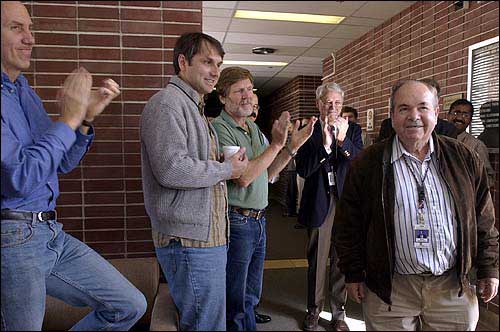
Alexei A. Abrikosov, right, is greeted with applause as he enters the lobby of his office at the Argonne National Laboratory in Argonne, Ill. Abrikosov is one of three winners of the 2003 Nobel Prize in physics.
The Swedish academy said researchers can use superfluid helium to study other physical phenomena, like how order can turn to chaos. Such research might illuminate the ways in which turbulence arises, one of the last unsolved problems of classical physics.