

Trash-eating bears face greater risks
South Lake Tahoe, Calif. ? The habitat of Lake Tahoe bears is not defined by their once-expansive range high in the snowy Sierra Nevada or surrounding pine forests. Here, the black bear’s domain can be measured in city blocks.
A year-round supply of garbage has lured the beasts to the streets that ring this resort area, known for its pristine blue waters, casinos and ski runs.
In settling into the easy life, the Tahoe bear has altered its hibernation cycle, taken to prowling the graveyard shift and grown fatter than your average bear.
The consequences can be deadly for the bears, according to a study in the Journal of Zoology that documents behavioral changes as the bears have adapted to a less-than-wild environment.
The study by Jon Beckmann and Joel Berger of the Wildlife Conservation Society debunked assumptions that the bear population was booming.
Instead, it found bears were moving from the mountains to neighborhoods, highlighting a growing problem across North America as housing creeps into wildlands and animals take advantage.
Historically, black bears in the Tahoe basin roamed up to 150 square miles and weighed 200 to 300 pounds, said Carl Lackey, a wildlife biologist with the Nevada Department of Wildlife who helped with the study.
Not anymore.
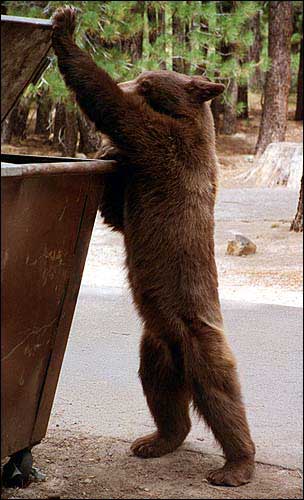
A black bear opens the lid of a trash bin, which wasn't equipped with a bear-proof latch, in search of food in October 1997 in Mammoth Lakes, Calif. Garbage has lured bears from the vast wilderness to the streets of South Lake Tahoe, Calif., better known for drawing tourists to its casinos and ski runs.
“At one point we had 12 bears within one square mile of a Dumpster,” Lackey said. “Good ol’ Burger King. Those Whoppers fed some whopper bears. We had several in the 450- to 550-pound range.”
For an animal with a 25,000-calorie-a-day diet, Dumpster diving is the fastest food available. The bears get their fill in a few hours by covering little ground compared with their wilder counterparts that spend more than 20 hours a day foraging for berries, nuts and carrion.
Already this year, Ann Bryant, of the Bear League, has recorded 17 bear deaths on the California side of the lake, compared with 15 last year, many involving vehicles.
Then there are the people: One woman set out a batch of syrup-slathered pancakes for the bears, and some parents smeared peanut butter on their children’s faces so they could photograph cubs licking it.
“The problem is not the bears,” Bryant said. “The problem is the people.”