

No victor in Rosie suit
Judge finds no damages to O'Donnell or publisher
New York ? A judge said Wednesday that neither Rosie O’Donnell nor the publisher of her former magazine deserved damages in their dispute over its demise.
Minutes after both sides rested in the case, state Supreme Court Justice Ira Gammerman issued his surprising comments concluding the two-week trial.
“It seems to me … we’re just dealing with bragging rights here, who wins and who loses,” said Gammerman, who heard the case without a jury.
The judge’s remarks effectively left neither side as the victor in a trial where O’Donnell’s image as the “Queen of Nice” took some hits and where the publisher was accused of manipulating the magazine’s financial figures. The judge did leave open the possibility that O’Donnell could ask for publisher Gruner+Jahr USA to cover her legal fees.
Gammerman said there was no evidence or testimony during the trial indicating that either side had caused the other to suffer damages.
Both parties invested money, the magazine lost money, and then it folded, he said.
“There’s no evidence that the magazine would have made any money at all,” he said.
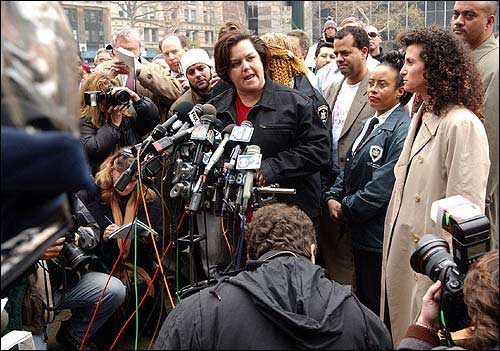
Rosie O'Donnell talks to reporters after leaving the state Supreme Court in New York. A Manhattan judge ruled Wednesday there is no winner in the court battle between O'Donnell and Gruner+Jahr USA, the publisher of her defunct magazine. At right is Cindi Berger, O'Donnell's publicist.
Gammerman’s comments from the bench were not legally binding, although he offered no indication to either side that he would reverse his opinion. The case began two weeks ago.
“I have no vengeance toward the company. … I’m simply happy about the fact that it is finally over,” O’Donnell said.
She thanked the judge and vowed never to discuss the company again.
O’Donnell, the comedian and former talk show host, quit Rosie magazine in mid-September 2002, and the magazine, which began publishing in April 2001, folded with the December 2002 issue.
The publishers sued O’Donnell for $100 million, alleging breach of contract for walking away. She countersued for $125 million, saying G+J broke its contract with her by cutting her out of key editorial decisions and manipulated the magazine’s financial figures.