

Franchises key to Lawrence store’s future
Piano business hopes to go nationwide by '04
Lawrence businessmen Christopher Hepp and Joe De Fio have a dream — change the piano industry and create a nationwide franchise of piano stores in the process.
Hepp and De Fio are hatching big ideas at their PlayPiano America store, 1410 Kasold Drive. The co-owners say the little store can serve as a blueprint for how to sell pianos and teach the instrument at a time they say is one of the toughest ever for the piano industry.
“We’re like the guy with the machine gun tapping the guy on the shoulder who is still fighting a battle with the bow and arrow,” De Fio said. “We have the machine that is going to save the industry.”
The machine, they believe, is the digital piano. A digital piano looks like any other piano, but instead of making music through a series of strings struck by hammers, the digital piano’s sound is created electronically.
The PlayPiano America store is unique partly because the only new pianos it sells are digital. The formula has worked for the store since it opened two years ago. Hepp said the store has turned a profit every month, even though the number of pianos sold industry-wide in the past two years has fallen to near an all-time low.
“People have said they have never seen the piano business in tougher times,” said Hepp, who also is an associate professor of piano at Kansas University. “But we’re still surviving.”
In decline since reaching a peak in 1910, piano industry figures put 2002 sales at $842 million. Though most of that — $693 million — was for traditional acoustic pianos, 83,000 of the 176,000 instruments sold were digital.
Expansion plans
The success has the Lawrence business on an aggressive expansion path. The company is close to finalizing a plan to begin franchising stores in all 50 states.
It expects to announce its first franchise location by January.
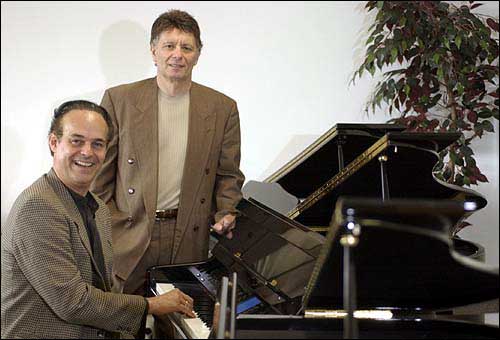
Christopher Hepp, seated, and Joe De Fio, co-owners of PlayPiano America, 1410 Kasold Drive, have built their business around digital pianos. The businessmen are working on a plan to open stores across the country beginning in 2004.
“We want to be the McDonald’s of piano stores,” said Hepp, who thinks there is a long-term potential for more than 1,000 PlayPiano America stores across the country.
The pair said there are two reasons the store can have success in cities across the nation. The first is that concentrating on digital pianos allows store owners to keep their inventory costs down.
That’s because stores selling traditional pianos, the acoustic ones, must keep several of the same model in stock. De Fio said that’s necessary because every traditional piano, even those of the same model, will sound slightly different because of the mechanical nature of the instrument and variety in the materials it’s made from. Digital pianos don’t have that variation.
“People who buy an acoustic piano are going to want to play the one that they actually take home,” De Fio said. “With a digital piano, you can feel comfortable playing one of the floor models and then letting us order it for you. It is great for us because that means we don’t have to keep a giant inventory on hand.”
Digital teaching
The other reason the pair believes the concept will be successful is that it does more than sell pianos. It also teaches students how to play.
The company, in partnership with Lawrence-based Athenix Solutions, has developed an Internet program that helps students learn. That program allows the company to have larger class sizes than traditional piano schools, Hepp said.
The company also uses all digital pianos to teach the students, which Hepp said helps keep students more interested in learning because a digital piano has more bells and whistles than an acoustic piano.
For example, digital pianos allow students to record their music, add background music while they’re playing — even change the sound to make the notes sound like a guitar or other instrument.
“Somehow piano lessons have become the boot camp of childhood activities,” Hepp said. “We think this changes that.”
Industry observers said the company’s efforts are unique. Brian Majeski, editor of the industry newspaper The Music Trades, said other companies have tried to start franchise piano stores but haven’t included an all-digital strategy or combined it with teaching.
Majeski, though, said the company will face plenty of challenges. He said that piano manufacturers traditionally have been reluctant to work with franchise companies because doing so takes away the amount of control manufacturers have over how their pianos are sold.
And not everyone is sold on digital pianos, he said, though PlayPiano’s sales numbers have been going up while acoustic sales have been declining.
“It has really taken over a lot of the entry level piano market, but it is not chewing way at the high end,” Majeski said. “People who are going to buy a really high-end piano, probably still aren’t going to buy a digital piano.”