

Al-Qaida changes tactics with more, smaller attacks
As U.S., European security increases, 'softer' targets will bear brunt of terrorist activity
Al-Qaida’s hit list appears to be changing.
American ships, embassies and financial hubs were the successful targets of Osama bin Laden’s organization until U.S. security was radically overhauled in the wake of Sept. 11.
Now the group, and those with possible links, are choosing “softer,” more international targets such as a Spanish restaurant in Morocco, a Kenyan resort frequented by Israelis and a Saudi housing complex home to both Americans and Europeans.
Four suspects with apparent ties to al-Qaida were arrested in connection with the recent suicide attacks on the housing complex in Riyadh that killed 25 bystanders, including eight Americans, officials said Sunday.
It was the strongest sign yet that bin Laden’s terrorists might have played a part in the bombings at complexes housing foreigners. Nine attackers died.
Interior Minister Prince Nayef said the four suspects knew about Monday’s attacks but did not take part in them. A Saudi official said they were arrested in the past three days.
More than 60 FBI and other U.S. investigators are assisting Saudi authorities with the probe into those attacks. U.S. officials have said Americans would assist — not run — the investigation into the attacks.
The three identified attackers were among 19 suspects being sought in connection with the seizure of a weapons cache discovered May 6 near one of the compounds. The 19 were believed to be receiving orders directly from bin Laden and had planned to use the seized weapons to attack the Saudi royal family and American and British interests.
And that means, experts say, that no longer are American targets the first or only choices.
More targets
Experts said the apparent broader range of targets were easier to strike and often serve double duty, fitting aims of both al-Qaida’s global approach and the local militants it worked through — from Africa to Asia to America. More alarmingly, such attacks are proving difficult to avert.
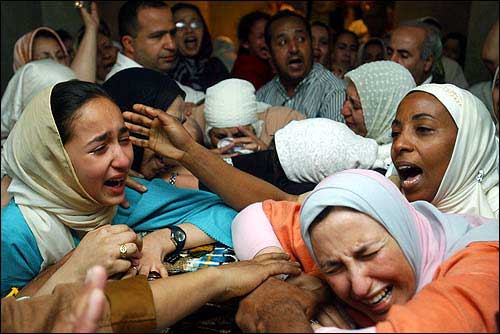
Relatives of Moroccan citizen Ben Ardi Elarbi, aged 49, mourn over his coffin at the family home in Casablanca, Morocco. Elardi, a father of three, was among about 40 people killed in a series of suicide attacks in Casablanca late Friday.
All of the recent attacks have been attributed, on some level, to al-Qaida and militant groups it works with. While those links are difficult to prove, the terrorist network’s familiar fingerprints are everywhere.
Al-Qaida, which began its activities in the early 1990s in opposition to U.S. troop presence in Saudi Arabia, the Islamic holy land, has broadened its agenda in recent years to target Western culture and commerce in general. It has claimed everything from Iraq to the Palestinian conflict as its interests.
“Al-Qaida itself and the Islamic radical organizations it’s connected to have a variety of possible targets, and they choose the ones that are easiest to attack and that will accomplish all their aims,” said Boaz Ganor, an Israeli counterterrorism specialist.
‘Not a problem’
Ganor said U.S. intelligence probably had milked all it could from suspects held in Guantanamo Bay, Cuba, and from some of the bigger al-Qaida operatives in U.S. custody such as Khalid Shaikh Mohammed, captured in Pakistan earlier this year. Bin Laden himself remains free, although the U.S.-led war in Afghanistan took away his longtime safe haven.
“If you don’t have new intelligence resources and new people to interrogate, then you find yourself confronting new planners and new initiatives that you don’t know anything about,” Ganor said.
Some 680 prisoners are being detained at Guantanamo, and a small handful arrived only last week. President Bush said earlier this month that “half of all the top al-Qaida operatives are either jailed or dead.”
“In either case, they’re not a problem anymore,” the president said.
Intelligence gleaned from interrogations there, and from arrests made in Europe, was believed to have helped thwart several attacks planned against U.S. targets in Italy, Britain and Singapore.
American, Jewish targets
Ganor said attacks in the last six months in Kenya, Saudi Arabia and Morocco were still aimed at killing Americans, although al-Qaida was also trying to galvanize fresh support across the Muslim world by striking at Jewish interests.
An ancient synagogue in Tunisia was attacked in April 2002, killing 21 people; an attack on Israeli tourists in Kenya in November killed three Israelis and nine Kenyans; and a Jewish community center and cemetery were among several targets bombed in Morocco.
In Russia, Foreign Ministry spokesman Alexander Yakovenko said bin Laden was trying to widen his holy crusade against the West.
“It is becoming ever more obvious that a terrorist organization with al-Qaida at its head is trying to shift to a counterattack against the entire civilized world after the defeat in Afghanistan,” Yakovenko said.
Vince Cannistraro, a former counterterrorism chief at the CIA, said the recent attacks showed that “al-Qaida is strong in those areas where they have indigenous infrastructure and benign environments.” As examples, he noted several attacks in Southeast Asia that had been tied to the al-Qaida-affiliated group Jemmah Islamiya.
But al-Qaida’s abilities are no longer as strong in Western Europe or North America, where Cannistraro said “the alert level is higher, and significant people have been taken off the streets.”