

Savile Row Tailor slashes ‘business casual’ down to size
London ? In an attempt to explain how men’s suits are made, Terry Haste, the managing director of H. Huntsman & Sons Ltd. on the famed Savile Row, dashes from his cramped office to locate a pattern for a custom-tailored suit. He returns with a stack of brown paper puzzle pieces lashed together with white string. They are so simple, so old-fashioned, one half expects that, as they land on Haste’s desk with a faint thump, a small dust cloud will swirl into the air.
There are far more pattern pieces than a single suit requires. What Haste has retrieved is more than a two-dimensional representation of a particular Washington customer’s physique. Rather, it is an entire history, dating to 1959, of a gentleman’s progression from wiry young attorney to legislator to member of the old guard.
Few purchases say as much about a man and the way he perceives himself as his decision to invest in a custom-tailored suit. And Huntsman is noted for making the most expensive suits on London’s Savile Row.
Over more than a century, tailors here have set the standard for the bespoke, or handmade, suit. There are fine suits to be had off the rack, and admirable suits are custom-tailored in other parts of the world. But Savile Row tailors have the expertise, the traditions, the reputation, the royal warrants and the clientele.
Popular culture has long exploited the message implied by bespoke tailoring. Filmmakers use the stock scene of a man conducting business in the presence of his tailor as cinematic shorthand for a gentleman of means and power. Pierce Brosnan conducted business during a suit fitting in “The Thomas Crown Affair.” Michael Douglas flexed his clout in front of his tailor in “Wall Street.” Every visible basting stitch makes an argument for the authoritative, indulgent and precise nature of the leading man.
A bespoke suit is not a midlife prize in the manner of a bright red sports car or a girlfriend half one’s age. Rather than fretfully envisioning themselves growing older, these men see themselves becoming more powerful.
The Savile Row suit represents the formal standard that everyone from Giorgio Armani to the Internet Wunderkinder@ have pushed and pulled against. Over the last decade, with the rise of business casual, the suit fell out of favor. Rigorous posture and respectful lines were overshadowed by the lackadaisical slouch of no-iron chinos and cotton-blend button-downs that cover but do not hide a paunch.
Back in the spotlight
In the past few years, the suit has returned to the spotlight, celebrated for its ability to connote authority, competence, power and masculinity. The suit’s presence has been demanded in a more formal White House, required for job interviews in a dispiriting economy, used as a tool in international diplomacy, seized as a symbol of a more serious, responsible culture. It is the most eloquent garment in Western civilization.
The suit is, of course, the uniform of a professional man. And a gentleman who considers himself as having arrived at the top of his profession will spend upward of $4,000 for a single suit cut to his specifications. There are some men who wear nothing but bespoke, such as the Turkish customer who orders 30 suits at a time from Huntsman. He has a multitude of houses and likes to stock his closets so he never has to bother with a suitcase. Although one might reasonably wonder: If a man can spend some $120,000 during a single shopping spree, wouldn’t he pay someone else to fret about luggage?
Guilty pleasure
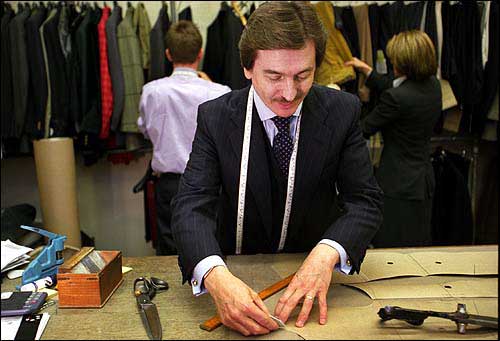
TERRY HASTE MEASURES AND CUTS material at Huntsman, which makes the most expensive suits on London's Savile Row. Some customers spend approximately ,000 for a suit cut to their specifications.
For other men, those who believe their rise to the top is assured or who have worked hard and now have the mountain’s peak in their sights, the custom suit is both a just reward and a guilty pleasure.
The volume of all tailored menswear sold in the United States increased by 9.2 percent over the 12 months ending in February, according to NPD Group, a market information company. But most men have been frugal and inventive, choosing relatively inexpensive suits, seeking discounts from companies such as Men’s Wearhouse, and rigging together a suit with a blazer and dress pants from places such as Banana Republic. The actual amount of money spent on tailored clothes has risen by only 4.1 percent, according to NPD.
‘Cleaner’ look
“The men’s market is … moving to a cleaner, more classic look,” says Marshal Cohen, co-president of NPD. “There’s more polish. But they’re not going to the traditional suit business.”
But the Savile Row man is not a statistic. Even when his office was embracing business casual five days a week, he did not engage in Dockers and polo shirts.
“When everybody in New York said, ‘We’re going to dress down,’ there was a massive trend to sportswear and sport jackets,” Haste says. “We’ve done more sport jackets and blazers. People were coming for advice. But in the last six months, people have been going back to suits.”
All of fashion, menswear and womenswear, has shifted toward a more polished aesthetic. The ready-to-wear industry is newly enamored of sturdy tweeds, more refined silhouettes and a more formal presentation.
Tradition of artistry
The difference between a custom-made suit and a Savile Row version is similar to the distinction between an evening gown stitched up by a respected dressmaker and one crafted in the French haute couture–although a Savile Row suit, even at $4,000, is a bargain compared with a lady’s $10,000 couture version. A suit that has been made on Savile Row carries with it history, a tradition of artistry and the sweet scent of entitlement.
Huntsman is known for its one-button, double-vented jacket with a sharp shoulder line and a slightly longer length. The jacket has a slim silhouette, fitting closely without being exaggerated. The trousers are slim; the addition of cuffs is a matter of customer preference. The jacket is finished with a traditional Huntsman lining: white with pale purple stripes.
The next time a senior legislator, corporate chieftain or veteran actor slips off his suit jacket, one might want to take notice of its lining. Huntsman, like most old-guard tailors, does not advertise the names of its famous clients, a somewhat quaint practice in an age when creators of everything from haute couture evening gowns to scented votives flaunt their celebrity endorsements.
Suit-making techniques
Huntsman offers exclusive tweeds and worsted wools that call to mind heather and hounds, barristers and lords. The fabrics are presented in a townhouse decorated with heavy-footed oak tables, a medieval-looking fireplace large enough to accommodate a suckling pig on a spit, and a grand mantelpiece above which hang enormous buck heads. In this environment, a silk-lined, tweed shooting waistcoat with a “suede leather gun patch” seems utterly practical even if the only thing one shoots on a regular basis is the breeze.
That men still turn to a company such as Huntsman, which has been tailoring suits since 1849, has as much to do with the firm’s suitmaking techniques as with the world’s unshakable Anglophilia, the belief that out of tradition comes integrity and the current longing for clothes that are unique or personalized. Technology allows the garment industry to manufacture perfectly fine suits that sell for a few hundred dollars.
Huntsman has been in business almost since the dawn of the modern suited man.
The tailored garment that so kindly provides pear-shaped men with shoulders and renders the couch potato athletic first appeared in the early 1800s, according to art historian Anne Hollander, author of “Sex and Suits: The Evolution of Modern Dress.”
The contemporary business suit had been foreshadowed in the late 17th century when men began to wear a loose-fitting buttoned coat. But in the 1800s, fashion turned. Preferences moved away from surface decoration to the beauty inherent in construction.