

Forsee steps in as Sprint chair
Esrey's replacement appoints new management positions
Overland Park ? Sprint Corp. chairman William T. Esrey stepped down Tuesday, handing the leadership position he had for more than a decade to new chief executive Gary Forsee, the company announced.
Forsee acted as chairman at Sprint’s shareholders meeting Tuesday but he made no reference to Esrey’s departure. At the meeting, Forsee introduced three men who were appointed to senior management positions.
Esrey’s resignation had been expected in conjunction with the shareholders meeting. Use of a questionable tax shelter led the board to force out Esrey, the company’s former chief executive, and Ronald LeMay, Sprint’s former president and chief operating officer, earlier this year. Esrey had retained his role as chairman during a transitional phase.
With Tuesday’s appointments, Forsee said Sprint’s senior management team was complete, although LeMay’s position has not been filled. After the shareholders meeting, Forsee told reporters that he was leaving that job open for now and was not sure he would ever fill it.
Forsee told shareholders he had spent the weeks since his hire completing a crash course in Sprint operating plans.
“I have come away convinced we are taking the right approach to tackling the challenges in front of us and have the assets and team to pursue our plan effectively,” Forsee said.
He told shareholders that the company’s top priorities must be to grow top-line revenues, improve customer service, improve Sprint’s bottom line, develop a “culture of winning” and further build Sprint’s brand.
He also said the company is “likely at some point” to eliminate the Sprint PCS tracking stock that reflects the performance of its wireless business. The telephone company continues to assess the timing and conditions under which that might occur.
Shares of Sprint FON, the company’s wireline business, closed up 12 cents to $11.80 in trading Tuesday on the New York Stock Exchange. Shares of PCS, Sprint’s wireless business, fell 7 cents to $3.78.
Forsee introduced three new officers to shareholders: Howard E. Janzen, president of Sprint’s Global Markets Group; Michael W. Stout, executive vice president and chief information officer; and Bruce N. Hawthorne, executive vice president and chief staff officer.
Janzen, 49, fills a position vacated in September when Len Lauer became president of the company’s PCS operations. LeMay had been leading the group until his resignation. Janzen leaves Williams Communications, where he was the company’s chairman, president and chief executive officer.
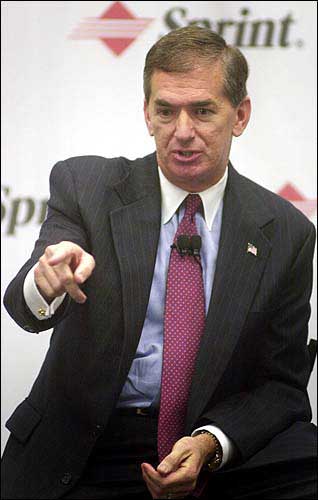
Sprint chairman Gary Forsee directs questions during a news conference in Overland Park. Forsee met with the media Tuesday following a shareholders meeting where he outlined his top priorities for the company.
Stout, 56, will oversee Sprint’s Information Technology Services. He comes to Sprint from GE Capital, where he served as chief technology and information officer.
Hawthorne, 53, has worked with Sprint as outside legal counsel for nearly 15 years. He will oversee integration of all Sprint staff operations.
Despite the company’s objections, shareholders approved a proposal concerning golden parachutes. The proposal requires Sprint to seek shareholders’ approval if a severance package is more than double the executives’ base salary plus bonuses.
Sprint is not legally obligated to enact the proposal, which was introduced by the Amalgamated Bank’s LongView Collective Investment Fund, but Forsee said the board of directors would take the vote under advisement.
Melissa Moye, chief economist for Amalgamated’s trust and investment services group, said it would be difficult for Sprint to ignore the vote.
Forsee also said Sprint’s audit committee will consider stockholders’ concerns about Sprint’s independent auditor, Ernst & Young. About 60 percent of shareholders voted in favor of the company’s proposal to keep the Kansas City, Mo.-based firm as its auditor. Normally, Forsee said, more than 90 percent of shareholders would approve such a measure.
Stockholders were concerned because Ernst & Young sold a questionable tax strategy to Esrey and LeMay — the same strategy that has come under IRS scrutiny and that led to the executives’ resignations. Some shareholders believe Ernst & Young’s independence was compromised.
Forsee defended Sprint’s decision to keep Ernst & Young. He said the votes on both the auditor and golden parachutes were a reflection of the current corporate climate.
“It wasn’t surprising to us,” Forsee said.