

Club hopes new pool boosts membership
Lawrence Country Club sees decline in numbers
Lawrence Country Club officials are hoping a new $500,000 swimming pool will create a new wave of interest in the club, which has seen its membership decline since the 2001 terrorist attacks.
Terry Schmidt, general manager of the club, said the 160,000-gallon swimming pool, twice the size of the club’s previous pool, is scheduled to open May 24.
The pool will feature a zero-depth entry, diving area, five competition-length swim lanes, deck and access to the club’s kitchen, Schmidt said. It is being built in place of the existing pool, just east of the clubhouse at 400 Country Club Terrace.
The pool is being built by Lawrence construction firm B.A. Green Construction and was designed by BG Consultants, which has offices in Lawrence.
Schmidt said board members primarily decided to replace the pool because it was 50 years old and was believed to be one of the oldest commercial pools still in operation in the state. He said it should appeal to the club’s changing membership.
“We’re seeing a lot more younger families joining the club, and that means we have a lot more kids using the pool,” Schmidt said. “It just seemed to make sense to have a larger pool.”
The club also is hoping the pool will help attract new members and reverse a trend of declining membership that began in 2001. During the past two years, Schmidt said the club has seen its membership drop from a high of 507 members to about 465 members today.
“We’re holding a membership drive associated with the pool opening,” Schmidt said. “We had a waiting list off and on for four or five years, and then Sept. 11 hit, and the economy dropped off. Now is the first time in quite awhile that we haven’t had a waiting list.”
Schmidt said the club’s popularity remains high, but the economy has created membership challenges.
“One of the biggest things is there have been a lot of job changes that have forced some of our members out of the area,” Schmidt said. “There’s probably been more of that than I can ever remember.”
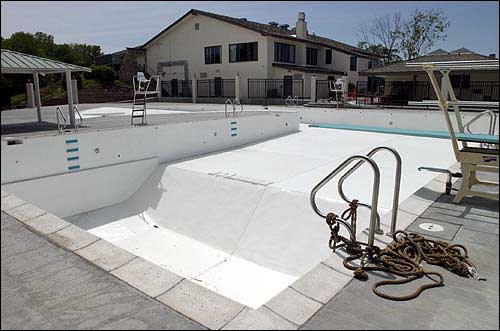
Lawrence Country Club hopes a new 00,000 pool will help attract new members. The club's membership has declined during the past two years. The pool, pictured on Wednesday, is expected to open May 24.
Schmidt said there are about eight different prices for various levels of membership.
He declined to comment on the cost of each membership.
National trend differs
The entire country club industry has been challenged since the economy turned sour two years ago, said Jim Singerling, chief executive of the Club Managers Association of America.
Singerling said membership trends have varied significantly from community to community, but he said the association’s 3,000 member clubs have not reported an overall decline in membership.
Instead, he said the clubs are reporting that club spending by corporations is declining, but the losses are being offset by increases in spending from individual members.
Corporations are spending less because they are limiting their expenses and taking a wait-and-see approach to the economy, Singerling said.
The increase in individual spending, though, may be a direct result of the 2001 terrorist attacks.
“We’re finding that members find the club an extension of their home,” Singerling said. “They see it as a predictable environment. One of the few predictable environments they have in their lives anymore.
“People have a lot of stress in their lives, and if they have a relief valve right there in their own community, that is going to remain attractive to them.”
Lawrence feels slump
The trend hasn’t exactly played out in Lawrence. Alvamar Country Club, 1809 Crossgate Drive, also has reported a decline in business.
Tony Portela, food and beverage director for Alvamar, said membership has not declined from its approximately 600 members, but there has been a drop in the amount of money club members spend on meals and other activities.
“I think they are just being more watchful with the market doing poorly,” Portela said. “People on fixed incomes are being more careful with their spending.”