

Space shuttle safety concerns addressed
Washington ? Unless NASA installs a crew ejection system in its space shuttles, it can expect to lose at least one more astronaut crew before 2020, a safety panel told the space agency’s top officials Tuesday.
Sidney Gutierrez, a member of NASA’s Aerospace Safety Advisory Panel who flew Columbia during a 1991 flight, said the agency’s record of two shuttle disasters violates NASA’s own safety margin requirements. The Feb. 1 Columbia accident re-duced safety margins two magnitudes below NASA’s minimums, he said.
“If we fly this vehicle until 2020, we can be assured we’ll lose another vehicle and maybe two,” he said.
Gutierrez said upgrades to other parts of the complex shuttle program would not bring the spacecraft in line with those safety requirements. Only a crew ejection system offered that promise.
“The gut feeling is, we’re losing people too often in space,” Gutierrez said.
The safety panel on Tuesday presented its latest report, which covered the months immediately preceding the Columbia shuttle accident. The 106-page report noted that it was finished before the Feb. 1 accident and that no changes were made because of Columbia.
The report also concluded that NASA should re-examine the way it certifies shuttles as safe to launch because of increasing problems discovered last year blamed on the shuttle fleet’s age. But it concluded that safety for the shuttle program has been a priority “first and foremost” at the agency.
Gutierrez challenged NASA to conduct new studies for designs of crew ejection systems, which could include individual ejection pods for astronauts or a reinforced, pressurized crew cabin designed to separate safely from a disaster.
Gutierrez said the safety panel does not believe NASA must install crew ejection systems before the shuttle’s next flight.
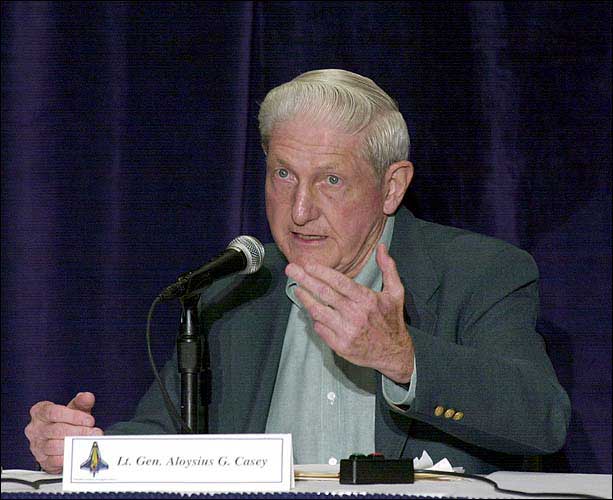
Aloysius G. Casey, an expert on safety and reliability for rocket systems, speaks at a public hearing sponsored by the space shuttle Columbia accident investigation board in Cape Canaveral, Fla. Casey said Tuesday that NASA should use robots and unmanned rockets whenever possible to reduce the potential for loss of life.
NASA’s associate administrator for safety, former astronaut Bryan O’Connor, said he was anxious to see studies on whether improved ejection systems can be installed on the shuttle. O’Connor, who was pilot on a 1985 flight of Atlantis and crew commander with Gutierrez aboard Columbia’s mission in June 1991, participates on the safety panel as an ex-officio member.
Columbia investigation
Tuesday in Cape Canaveral, Fla., a missile and rocket expert told NASA that robots and unmanned rockets should be used whenever possible in order to minimize risks to human life.
Aloysius Casey, a retired Air Force lieutenant general, also recommended to the Columbia Accident Investigation Board that space shuttle flights resume as soon as possible. The work force, skills and even morale could erode to dangerous levels if the fleet is grounded for a long time, he said.
Casey put the shuttle’s reliability at just over 98 percent, far better than for unmanned rockets, “but, in fact, I don’t think it’s good enough for optional human flight operations.”
Casey, a consultant who was commander of the space division of the Air Force Systems Command, spoke in the third round of hearings before the board looking into the cause of the Feb. 1 shuttle disaster that killed seven astronauts.
Steven Wallace, a board member in charge of accident investigations for the Federal Aviation Administration, suggested that a reliability level of 98 percent would not suffice for commercial airlines.
“In 2000, we operated 11 million flights, 32,000 a day and without a single fatality,” Wallace said. “Operating on this level of reliability, we would lose 640 of those airplanes every day.”