

Companies ready to cut travel
Looming war puts international business trips in limbo
Aric Peters packed his bags last week for a business trip to Indonesia, but he’s ready to hop the first plane back to Kansas if the United States goes to war with Iraq, and stay home until the conflict ends.
Corporate travel managers say more businesses are preparing to postpone or cancel trips as the threat of war looms. Others are revising travel policies to make sure they know where their employees are and how to get them home quickly.
“From here on out, our travel is probably going to slow a great deal, especially if the war starts,” said Peters, who often goes overseas as international sales manager for aerospace and defense contractor Butler National Corp.
His company has put off planned trips to the Middle East and will likely rely more heavily on telephones and computers to keep in touch with clients in case of war, Peters said.
He left Thursday for Indonesia but isn’t sure whether he’ll make a planned trip next month to Singapore.
A survey of 151 companies last month by the National Business Travel Assn. found more than 60 percent planned to evaluate business trips on a case-by-case basis if war begins; about a quarter said they would increase the use of teleconferencing.
Although the majority — 61 percent — said they had no immediate plans to reduce travel, travel planners said they expected to see a drop-off in business trips if the United States goes to war with Iraq.
First Data Corp., an international payment services company based in Greenwood Village, Colo., isn’t taking any chances. The company banned international travel for its U.S. employees last week and instructed those overseas to return.
“The safety and security of our employees is of paramount importance at all times, but particularly now,” spokesman Greg Rossiter said.
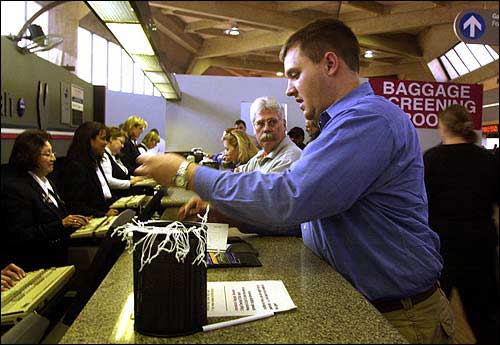
Many U.S. companies are scaling back employee travel in light of possible war with Iraq. Aric Peters left Thursday from Kansas City International Airport for a weeklong business trip to Indonesia, but he's prepared for a quick return if war begins.
The company will likely expand its restrictions, possibly to domestic travel, in the event of war, Rossiter said.
Alex Wasilov, president of Rosenbluth International, a global corporate travel management company based in Philadelphia, said he expected businesses would cut international travel by 10 percent to 20 percent and domestic trips by 5 percent to 10 percent after the start of a war.
Wasilov said he hoped any conflict would be short — weeks, not months — and that business travel would bounce back quickly. Even so, he said corporate clients were making provisions to stick closer to home if war begins.
“Certainly all of our clients are looking for airlines, hotels and car rental agencies to be more flexible in terms of cancellations,” he said.
| A survey of 151 companies last month by the National Business Travel Assn. found more than 60 percent planned to evaluate business trips on a case-by-case basis if a war with Iraq begins. |
The major airlines, struggling with losses since travel dropped off after the Sept. 11 terrorist attacks, are doing what they can to encourage people to keep flying. They have announced policies that generally eliminate penalties for travelers who reschedule flights in the event of war. Some hotel chains have instituted similar policies.
The airlines say a war with Iraq would cost them $10.7 billion and force them to cancel nearly 10 percent of daily flights.