

Fed chair predicts high gas prices
Washington ? High natural gas prices are likely to last into next year, and could weaken some key American industries’ ability to compete, Federal Reserve chairman Alan Greenspan said Tuesday.
Greenspan stopped short of suggesting that tight natural gas supplies, which have caused prices to more than double from last year, might thwart economic recovery.
Industries that heavily rely on natural gas hope that prices will decline, but Greenspan said market signals suggest tight supplies and high prices will persist because — unlike oil — the U.S. gas market is unable to easily draw on world supplies to meet surges in demand.
“The markets are telling us that $2 gas is a historic relic — at least for the time being,” Greenspan told a hearing of the House Energy and Commerce Committee. Natural gas at wholesale has surged to $6.25 per thousand cubic feet, compared to an average of about $3 last year.
“We are not apt to return to earlier periods of relative abundance and low prices anytime soon,” said Greenspan, adding that market expectations “imply a 25 percent probability” that the peak price natural gas on the wholesale market could exceed $7.50 per thousand cubic feet by next January, in the middle of the winter heating season.
Greenspan said that already the increase in gas prices has “put significant segments of the North American gas-using industry in a weakened competitive position” against industries overseas.
“Unless this competitive weakness is addressed, new investment in these technologies will flag,” he continued. The fallout from the high energy costs has been tempered because companies have made temporary adjustments, hoping prices will decline.
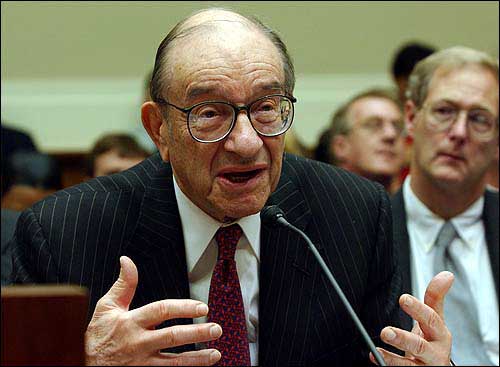
Federal Reserve Board Chairman Alan Greenspan discusses natural gas supply-and-demand issues during an appearance before the House Energy and Commerce Committee on Capitol Hill. On Tuesday, Greenspan predicted tight supplies of natural gas and high prices for a long period.
The Energy Department also has forecast that extremely short supplies of stored natural gas will result in high prices through this year and into 2004. Gas stocks in storage were 38 percent below what they were last year and 28 percent lower than the five-year average.
“An abnormally hot summer, followed by a cold winter could push natural gas deliverability to the limit and cause record high prices,” Guy Caruso, head of the department’s Energy Information Administration, told a congressional hearing.
Greenspan said the supply and price problems stemmed from “a modest gap” between growing demand for the environmentally friendly fuel and supplies that are limited.
“Rising demand for natural gas, especially as a clean-burning source of electric power, is pressing against a supply essentially restricted to North American production.”
He urged expansion of liquefied natural gas, or LNG, imports, so that the U.S. market can more easily use world gas supplies as “a safety valve” if North American supplies become too tight.