

Program aims to boost oil production
KU, Kansas Geological Survey lead efforts to tap into state's existing wells
RUSSELL ? Watching the oil rig crew push one length of pipe after another beneath the ground, Stan Froetschner talks about the prospect of recovering more oil in Kansas.
“I can’t see where there will be boom times again, but it will help get the oil out of the ground,” said Froetschner, overseeing the work crew.
The “it” is a $4.4 million pilot program financed by public and private money to try something never tried in Kansas — using carbon dioxide to recover oil.
But Froetschner, production superintendent for Murfin Drilling which is doing the field work for the pilot program, isn’t ready to declare victory.
“We’re trying to see if it works. It’s a scientific experiment. If it works, it can be expanded to other wells,” he said. “It’s a good learning experience if nothing else, but you have to be optimistic.”
When the first wells were drilled in 1938-39 in Russell County, there was enough natural pressure to bring some of the oil shooting to the surface.
“It’s like shaking a soda bottle and spewing out some, but leaving some still in the bottle,” said Paul Willhite, co-director of the Tertiary Oil Recovery Project at Kansas University and professor of chemical and petroleum engineering.
The recovery project is a separate university research group that works with the Kansas Geological Survey to oversee the pilot program.
The pilot program, started in 2000, is on a small section of the Hall-Gurney oil field southeast of Russell in the rolling wheat fields.
Three producing wells soon will be ready to receive oil from 2,900 feet below ground. An injector well will push carbon dioxide in fluid form into the ground at 2,000 pounds per square inch, some 130 times greater than atmospheric pressure.
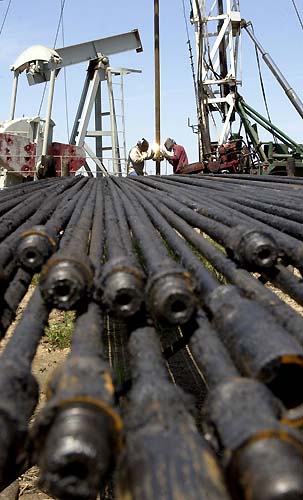
Workers weld together joints of pipe as they prepare a production well in a pilot project using carbon dioxide to recover oil in an old well field near Russell. The project is a joint venture between public and private interests and will be the first attempt to use the carbon dioxide technology in Kansas.
Hopefully, everything will be ready to start pumping the carbon dioxide into the ground in late summer or early fall, Willhite said.
“This is pioneering work in Kansas,” added Willhite, “We have to show we can displace the oil with CO2 and what the operating costs will be.”
Acting as a solvent, the injected carbon dioxide dissolves some oil and pushes it like a large black wave through porous limestone rock to the producing wells where it’s pumped to the surface.
“It leaves little bitty blobs that are disconnected and water can’t push them out. You have to come up with something different from water to push the oil out,” Willhite said.
The pilot program’s recovery should peak in about two years and be completed in about six years. Willhite said there was no way of knowing how much oil could be recovered until the projected was completed.
If the program succeeds, it could be expanded to other areas of Hall-Gurney and eventually yield up to 20 million barrels in that area. In 2001, Hall-Gurney produced some 533,000 barrels of the statewide total of 33.3 million barrels.
The area was picked because it has the state’s largest formation of Lansing-Kansas City limestone, a formation that statewide accounts for about one-fifth of the oil produced.