

Britain awaits verdict on euro
Currency creates debate in Europe
London ? From Athens to Amsterdam, or Barcelona to Berlin, travelers in Europe need never change money — until they cross the English Channel to Britain. Here, the euros in their pockets must be exchanged for those time-honored pounds and pence.
On Monday, in what would be a setback to the dream of ever-deeper European unity, the British government is widely expected to announce that it wants things to stay that way for now.
Prime Minister Tony Blair’s government says it favors joining the single currency in principle, but the country sat warily on the sidelines when 12 of its European neighbors ditched their own currencies and adopted the new euro notes and coins on Jan. 1, 2002.
Now Blair’s Treasury chief, Gordon Brown, is expected to say that the economic tests he set in 1997, which must be passed before Britain calls a referendum on euro membership, haven’t yet been met.
The issue has split Britain. The euro’s opponents say it will weaken the economy and the nation’s sovereignty. Supporters say that if Britain spurns the euro, it will be left in the dust of a united Europe forging ahead to superpower status.
But the debate may be entirely academic. A succession of opinion polls say most Britons would vote “no” to the euro in a referendum.
Although it joined what is now the European Union 30 years ago, Britain has often been accused of standing apart from the grand design of a united Europe. The division grew widest under Prime Minister Margaret Thatcher, who feared her free-market conservatism would be slowed by the welfarism and trade union power prevalent on the Continent.
But even after Thatcher’s Conservatives were replaced by Blair’s Labor Party, the ambivalence persisted. Britain, Sweden and Denmark were the only countries that opted out of the euro when it was launched for financial transactions on Jan. 1, 1999, and went live as a currency two years later.
How bad would another “no” from Britain be for the euro on Monday? Daniel Gros, director of the Brussels-based Center for European Policy Studies, said the EU is eager to have its third biggest member economy on board — but won’t be heartbroken if it doesn’t immediately join.
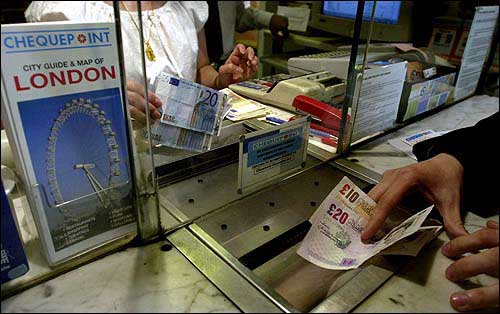
A customer at a bureau de change in Victoria, central London, hands over 30 pounds or 6 in exchange for 40 euros. The British government will announce Monday whether it wants to keep its current currency or adopt the new euro notes and coins.
Britain, whose economy was once so strike-ridden that it was derided as “the sick man of Europe,” now has around double the growth and half the unemployment of the euro zone. The reforms that have made this possible could rock the boat and “would mean a lot of political problems,” Gros said.
Rejecting the euro would be a prestige blow to the architects of the new Europe. Moreover, analysts say, it could worsen Britain’s already frosty relations with some of its neighbors and widen cracks that opened over Blair’s alliance with President Bush in the Iraq war.
To France, the euro is a test of Britain’s “European-ness.”
Blair believes Britain needs to embrace the euro if it is to be at the heart of European decision-making.
“I don’t think there could be anything more damaging for British influence, for British jobs, for British industry, than if Britain were to retreat to the margins of Europe,” he said at a news conference last month.
But he has always insisted that the economic conditions must first be right. In particular, he needs to convince a skeptical British public that it is in their best interests, rather than risk losing a referendum.
Meanwhile, the euro has risen more than 30 percent against the dollar this year, reaching an all-time high of $1.1932 on May 18, and that may strengthen the anti-euro camp in Britain because a high-value euro makes the exports of the euro nations more expensive.