

Baseball, especially in the last three years, has seen greatness in the feats of Bonds
Chicago ? Babe Ruth was a round-bellied 38-year-old when baseball’s first All-Star Game was played at Comiskey Park in 1933. He clearly had seen better days, but the idea of an All-Star Game without the flamboyant and beloved “Bambino” was unthinkable.
Ruth, ever one to seize the moment, left his imprint on the game with the first home run in All-Star history as the American League won, 4-2.
Seventy years later, the 74th All-Star Game features another 38-year-old who evokes images of Ruth, sans the belly and the cheery disposition and the dogged pursuit of a good time.
Barry Bonds is coming off back-to-back MVP seasons, the first of which featured 73 home runs and a slew of other records, the second a .370-average batting title. He leads the major leagues in home runs. He is fourth and climbing — fast — on the career home run list. He has stolen more than 500 bases and still plays a credible left field.
Even purists who are dismissive of baseball’s recent offensive explosion — they cite smaller ballparks, flawed pitching and chemically enhanced players — acknowledge that Bonds, 10 days short of his 39th birthday, is something special. Not since Ruth has anyone hit them as hard, as far, and as often … and raw power is only part of the package.
Dusty Baker probably knows Bonds better than anyone, having managed him for 10 years and through three of his record five MVP seasons. There’s no question of Bonds’ stature in his mind.
“He’s the best hitter there is, No. 1,” Baker said. “He has tremendous power, he doesn’t strike out, he doesn’t swing at bad pitches, he has tremendous discipline and knowledge of the strike zone.
“He’s getting a little older in the outfield, but he’s still a very smart player. He can do whatever he wants to, basically. He seems to know what the pitcher is going to do and he makes adjustments very quickly. The only guy I ever saw with that kind of anticipation was Hank Aaron, and Hank’s my role model in terms of what a great player should be.”
Aaron, Willie Mays, Frank Robinson, Roberto Clemente … all were in their prime in the 1960s, when the speed-and-power brand of baseball featured in the National League was probably the best ever — Hall of Famers at every position, enough outfield depth to stock two All-Star teams. There were no five-time MVPs because there were too many MVP-type performers. Cubs broadcaster Ron Santo was the Cubs’ third baseman in that era, and he believes Bonds would have fit right in.
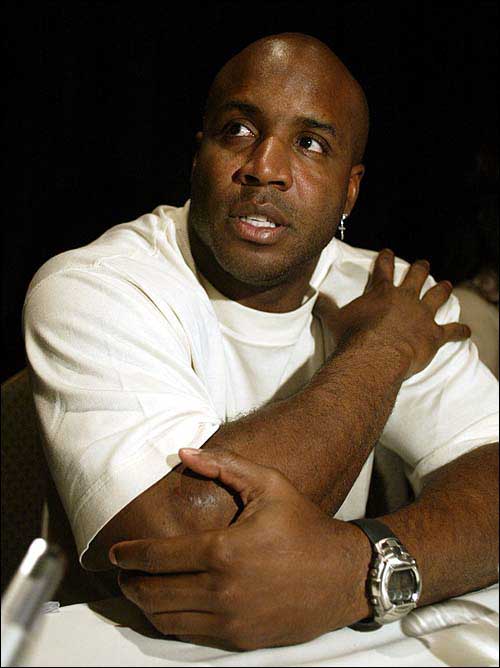
“He would have held his own in any era, no question — he’s that good,” Santo said. “Would he have hit 73 home runs in our era? That I don’t know. I will say this — he would have been hit, or at least thrown at, a lot more. Those pitchers in my day, they were out there to earn a living, too, and they took it personally if you took ’em deep.”
Santo laughed as he recalled his experience with a pitcher who personified the times.
“I got called up to the big leagues, and on the plane I’m reading Sport magazine with a cover story that says, ‘Don Drysdale, Head Hunter.’ I hit behind Ernie Banks that year. Ernie hit 44 home runs, and every time he hit one off Drysdale I’d go down. Later we became pretty good friends and I said to him, ‘Donny, Ernie’s the guy hitting the home runs, wearing you out. Why are you throwing at me?’
“He said, ‘When I cross the white lines, buddy, nobody’s my friend.’ That’s how the game was played.”
Bonds was hit nine times in his 73-homer season in 2001. Sammy Sosa was hit once when he hit 66 homers in 1998.
“It’s a different game today — guys don’t pitch inside,” Santo said.
Like Santo, Tim McCarver came of age as a ballplayer in the ’60s. He was originally called up to the Cardinals at age 17 and was their regular catcher at 22. With more than 40 years in the game, McCarver has exacting standards for how it should be played, and he readily gives voice to them as Fox TV’s lead analyst. Watching Bonds, he recalls the awe he felt watching Mays and Stan Musial as a teenager.
“Barry says he was born to hit a baseball, but I’d take that a step further — he was born to be a baseball player,” McCarver said. “In addition to immense physical talent, he’s a very smart player, very aware, with great instincts for the game. There isn’t anything he can’t do.”
Atlanta Braves broadcaster Don Sutton became a true believer during last year’s postseason, when Bonds hit .356 with eight homers and 16 RBIs in 17 games, including 8-for-17 with four homers in the World Series.
“That was the one thing people could pick at him for — he hadn’t been a good postseason player,” Sutton said. “It was like he put the Giants on his shoulders and said, ‘Let’s get rid of that label.’ He was phenomenal.”
Sutton began his Hall of Fame pitching career in 1966 and faced all the great hitters of the era.
“I had the privilege of playing against Roberto Clemente late in his career, and I always thought he was the most complete player I ever faced,” Sutton said. “I’d put Bonds in that category. The power, the running, the plate discipline — there isn’t anything he can’t do.”
Atlanta outfielder Gary Sheffield might not rival Bonds as the game’s No. 1 offensive threat, but he’s in the team picture. Sheffield has a two-word synopsis of Bonds’ place in baseball.
“Best ever,” he said. “No doubt. To do the things he’s done over the period of time he’s done them, no doubt.”
Sheffield believes Bonds’ slugging overshadows his attributes as an all-around player. “He’ll do whatever his team needs — take a walk, steal a base, make a play in the field, whatever it takes,” he said.
And Sheffield has tried to pattern his game after Bonds.
“What I’ve learned from him is don’t be afraid to take a walk,” Sheffield said. “You won’t swing at as many pitches, and the ones you swing at are more likely to be strikes that you have a better chance of doing something with. The year Barry hit 73 homers his on-base percentage was something like .500 (.515). You’re helping your team if you’re on base that often.”
MVP awards, Silver Slugger awards, Hank Aaron awards — Bonds could accessorize Pac Bell park with his career hardware. About the only thing he hasn’t won, and probably never will, is Mr. Congeniality. Bonds has a prickly personality, to put it mildly, and being a fan favorite and/or a media darling simply isn’t a concern of his.
Yet it doesn’t appear to affect his standing. The proof is in the performance.
ESPN Magazine senior writer Tim Keown covered Bonds’ first two seasons with the Giants for the San Francisco Chronicle and has written about him often for the magazine.
“As a journalist dealing with Barry Bonds, you have to understand two things,” Keown said. “No. 1, he doesn’t care. He doesn’t care if you have a deadline. He doesn’t care if your editor wants you to ask a certain question. He doesn’t care about your life or your job or your problems. But if you do your job, ask decent questions and avoid sucking up, you’ll get answers when you need them.
“No. 2, if he hits three homers, stay away. He won’t give you the time of day. But you want to be there if he strikes out three times and pops up with the tying run at third. That’s when he’ll sit at his locker and give you 15 minutes of insight.”
Henry Schulman, on the Giants’ beat now for the Chronicle, says it’s “difficult” covering Bonds on a daily basis.
“He often refuses to talk after games, particularly when he hits home runs,” Schulman said. “He’s actually more accommodating and quotable when he’s going poorly.
“Sometimes, though, he doesn’t like the backlash from what he says and then blames the writer for misquoting him.”
Chronicle columnist Bruce Jenkins chooses to write about Bonds — often glowingly — without talking to him.
“I don’t need Bonds’ words to augment what he’s doing — which is the most remarkable stuff I’ve seen on a baseball field since the Mays-Aaron-Clemente era,” Jenkins said. “Nobody can tell me there was a better ballplayer than Mays, or a better pitcher than Sandy Koufax, and until Bonds came along I’d never seen anyone in that category.
“For power hitting, Bonds goes past all of them, all the way back to Babe Ruth’s time. He’s not the all-around player Mays was, can’t come close to him in terms of outfield play. But strictly for power hitting … he turns that one-strike-per-night diet into a 450-foot homer. He has the most remarkable bat speed in anyone’s memory. He dead-pulls shots that somehow stay fair when the next guy’s identical-looking shot hooks about 15 feet foul.
“To me, watching Bonds is like watching Mays, Bill Russell, Johnny Unitas,” Jenkins said. “You don’t miss a pitch, ever, whether you’re in the stands or in the kitchen. And that’s how I write it. I actually enjoy being separated from the man himself, by my own choosing. My thoughts aren’t cluttered up by petty issues.”
Nick Peters of the Sacramento Bee has covered Bay Area baseball for close to 40 years — he saw nearly as much of Bobby Bonds as he has Bonds’ son.
“Keep in mind that Barry didn’t truly become a player of legendary stature until his incredible 2001-2002 double — 73 homers, then a .370 average,” Peters said. “For that reason alone, I can’t place him above players like Ruth, Ted Williams, Aaron and Mays, who were great from the start. But numbers alone and remarkable longevity place Bonds on any top-10 list.”
Peters believes Bonds is making attempts to be more accommodating as his fame catches up with his talent.
“What comes through to me is that Barry enjoys the trappings of fame, but not the responsibilities that go with it,” he said. “A guy with his good looks and toothpaste-ad smile should be a beloved soul, and he’s not. Perhaps that bothers him, but it’s his own doing. I see a happy guy on camera, but otherwise someone who doesn’t seem to be enjoying himself.”
Sutton has a similar take.
“I only hope he’s enjoying what he has accomplished as much as we’ve enjoyed watching him do it.”