

Of mice and money
Missouri businessman sells thousands of rodents weekly
Otterville, Mo. ? Jim Wallenburn found his niche for business success through a quirk of fate.
After years of selling rabbits to a Chicago firm, he found a different and more profitable crop — mice.
“I was delivering a load of rabbits in 1984, and they were complaining that their mouse supplier was retiring and they had nowhere to turn. I bought the equipment, brought it home, bought some breeders and let nature take its course,” Wallenburn said.
Now, on his small holding east of Otterville, Wallenburn keeps about half a million mice and sells thousands of the tiny rodents each week.
What were once buildings holding rabbit hutches have been split into rooms. Each room holds cage after cage after cage of little critters that end up as lunch for zoo-owned birds and snakes all around the Midwest.
“If you take Dallas, Denver, Milwaukee and Memphis and draw a circle connecting the four you’ll have our market area,” the mouse rancher said. “We deliver most of them ourselves, but several people come and pick up their orders, and the orders for Florida and California are shipped by Federal Express.”
His vans are loaded with orders and are on the road most of the time. Wallenburn declined to discuss the price of his mice.
“We deliver to zoos, mainly, but also to several bird rehabilitation centers. There’s an owl rehabilitation center and a raptor rehabilitation center, both in Illinois, that require the colored mice.
“If a bird is going to be returned to the wild, you can’t get them used to eating white mice; they won’t find white mice out in the countryside where they’ll have to do their hunting once they’re back on their own.”
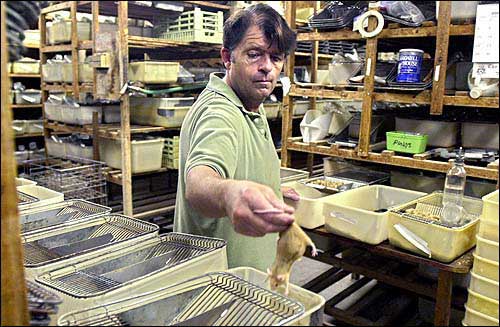
Jim Wallenburn puts a mouse in a tray at his business, Wallenburn Rabbitry, near Otterville, Mo. Wallenburn has been raising mice for 20 years. He said he sells thousands of mice weekly, delivering them mainly to zoos and pet stores.
Wallenburn said zoos aren’t as choosy about colors since their snakes and birds will be kept inside for their entire lives and will eat any mouse put in their cage.
The sheer numbers are amazing. Wallenburn buys his breeding mice from laboratory surpluses and puts six females with one male. Every couple of days the pregnant females are taken out of the breeding cages and placed two to each birthing cage.
“The gestation period is 18 days, and each female will have from 15 to 18 babies. Then I have to start looking at the orders I have to fill,” Wallenburn said.
He said the mice are sold by their ages, some are sent off on the day that they are born.
“Mice one to four days old are called pinkies. There’s a big call for them for birds. Five to seven day mice are called fuzzies, seven to nine days are eyes-shut, nine to 11 days are eyes-open, 11 to 14 days are hoppers, 14 to 21 days are weaned mice, and anything older than that is an adult mouse,” he said.
Jim, his wife, Pam, and two other employees spend many days filling orders to be loaded for shipment the next day.
“Pam is not your ordinary farm wife,” Wallenburn said. “She’s right out there with us filling shipment cages, making sure all the mice have food and water and then goes in and keeps the books and cooks the meals. She’s not at all squeamish.”
Food and water for the mice are a big issue. Glass bottles with drip spouts, just like one would find in a hamster or gerbil cage, feed clean, fresh water into every cage.
And what would mice eat?
“Purina Mouse Chow, of course,” Wallenburn said. “We feed about a ton of Purina every week.”
Like formulas that Purina develops for other animals, mouse chow has specific ingredients to help his animal grow and stay healthy, Wallenburn said.
“Mouse chow cubes are basically grain products and mixed so there is about 12 percent fat content. That’s what helps them stay uniform in size and more saleable,” he said.
But mice don’t have to be fed every day or twice every day like many farm animals.
“They eat the cubes through the wire containers and we only have to fill them when they start running low,” he said.
Wallenburn starts with healthy breeding mice, so there is no problem with sickness in his pens, and he doesn’t have to worry about doctoring his animals.
“We don’t give them extra vitamins or antibiotics because the zoos and other buyers want them completely organic,” he said. “That’s what they need to feed their animals.”
Wallenburn said he sometimes takes a ribbing about being a mouse rancher, but he always has an answer for the jokers.
“I just mention that I don’t have to be out there tossing hay off a wagon when the winds blowing 90 and the temperatures below zero,” Wallenburn said. “And I won’t be up to my knees in manure, forking it into a spreader. Raising mice isn’t such a bad life.”