

Keeping the spirit alive
Martin Luther King Jr. event to celebrate progress
The recent Trent Lott episode, in which the U.S. senator from Mississippi seemed to speak wistfully of the days of segregation, appeared to outrage most Americans.
But it didn’t necessarily come as a shock to many African Americans — the Rev. William Dulin among them.
Pointing to a verse from the Gospel of Luke, Dulin notes that Lott’s sentiments about race were bound to come to the surface.
That biblical passage reads: “Therefore, whatsoever you have spoken in darkness, it shall be heard in the light, and that which you have spoken in the ear in the closets, shall be proclaimed up on the housetops.”
In other words, what’s in a man’s heart will likely emerge sooner or later.
Lott’s comments spoke volumes about racism to Dulin, longtime pastor of Calvary Church of God in Christ, 646 Ala.
“It’s much alive. Riding in the back of buses, that’s dead. But when you look at it from the economic side, the privilege side, it’s still there, just kind of hidden,” he says.
“No matter how much people hide it, they’re still thinking that way. If people are honest and straightforward, we can get over a lot of these bridges. I thank God that things are better, but they can be better still.”
Dulin is president of the Ecumenical Fellowship of Lawrence, an association of the city’s historically African-American churches.
Each year, the group organizes the Martin Luther King Jr. Holiday Celebration in Lawrence. The fellowship is now preparing for the 18th annual event.
The celebration, which will feature an educational program, banquet, gospel musical and commemorative service, will be held Jan. 16-20.
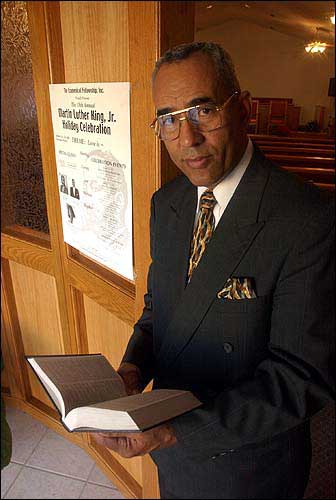
THE REV. WILLIAM DULIN, longtime pastor of Calvary Church of God in Christ, 646 Ala., is president of the Ecumenical Fellowship of Lawrence. The association organizes the Martin Luther King Jr. Holiday Celebration each year.
To Dulin — in light of the Lott episode — the community event honoring the civil rights leader has never been more relevant.
“We know that underlying current (of racism) is still very much present in our society,” he says.
“And I feel that’s one of the reasons it’s very important this celebration continues to bring to the forefront of people’s minds that there’s much more yet to be done.”
Keep on pushing
Like Dulin, the Rev. Gregory Gray wasn’t surprised by the comments Lott made at the 100th birthday party of U.S. Sen. Strom Thurmond (R-S.C.).
“My gut reaction is that he just said what a lot of people have on their minds anyway. A lot of us play Christian on the outside, but we still have issues on the inside. He was just being truthful about how he feels inside,” says Gray, pastor of St. James AME Church, Seventh and Maple streets.
The upcoming celebration of King and his philosophy of equality for all Americans brings up a rich memory for Gray, 55, who grew up near Chicago.
“Martin Luther King walked right by our complex in 1963. And I marched with him for four blocks, just as a young kid. I must have been around 14,” Gray recalls.
“I got a shirt with his picture on it, and it says, ‘Marching to Success.’ I still have it.”
Forty years later, Gray does see evidence of improvement in racial relations. He doesn’t have to look past the integrated pews in front of him on Sunday.
“My own church has little white girls and boys walking hand-in-hand with little black girls and boys. That’s living proof that King’s dream has become reality. We all just have to keep pushing,” Gray says.
Eradicating racism
Lott’s musing about Thurmond’s 1948 presidential candidacy — based on an openly segregationist platform — brought back memories of a different sort for the Rev. Verdell Taylor.
“I had a gut-level reaction going back to my youth. I had my own experiences (with racism) growing up in Leavenworth,” says Taylor, 58.
He has served as pastor of St. Luke AME Church, Ninth and New York streets, since 1995.
“I went to all-black schools through the eighth grade. I was not allowed to go to junior high school because there wasn’t one for black students. So I went on to a (grades) 9-12 high school. With those experiences, a lot of things came up (in reaction to Lott’s comments),” he says.
Racism remains a problem for African Americans today, according to Taylor.
“I may be more sensitive to this simply because I’m a black man, but sometimes you’re perceived a certain way based on how you look, how you dress. If you’re dressed like you’re doing chores around the house, you’re more likely to face racism,” he says.
“The bottom line is I’m treated differently when I’m wearing my collar as a minister. Suddenly, more people are speaking to me and acknowledging me.”
The Martin Luther King Jr. Holiday Celebration should not just be about getting a good feeling on one particular holiday. Rather, Taylor says, the philosophy of the event should be carried on every day of the year.
“With the celebration that’s coming up,” Taylor said, “each individual who’s going to participate needs to ask himself, ‘How can I make a difference in 2003? What can I do?’ If everyone does some soul searching, then we’ll start to eradicate some of the racism that I spoke of.”