

Students pan INS registration rules
Later this month, immigration officials expect to photograph, fingerprint and interview dozens of Kansas University students from Pakistan and Saudi Arabia.
“It’s not a big, drawn-out process. It takes about 20 minutes,” said Mike Heston, district director at the U.S. Immigration and Naturalization Service Office in Kansas City, Mo.
“Temporary foreign visitors” from Pakistan and Saudi Arabia are to report to the office between Jan. 13 and Feb. 21. Those who don’t risk “arrest and removal,” Heston said.
The visits are required under the third phase of the National Security Entry-Exit Registration System, a registration program passed by Congress and carried out by U.S. Atty. Gen. John Ashcroft in the wake of the Sept. 11, 2001, attacks.
But several KU students who will be required to report beginning Jan. 13 say the exercise is short-sighted, ill-conceived and an invasion of their privacy.
“Why am I, as a Pakistani, being singled out?” asked Adnan Chaudhry, a 21-year-old senior majoring in computer science at KU. “None of the (Sept. 11) terrorists were from Pakistan.”
Nevertheless, Chaudhry said he would report to the INS on time.
“I’ll let them take my picture and take my fingerprints, but I will feel discriminated against,” he said.
“What they’re doing is racial profiling; it’s harassing people because of where they’re from,” said Ambereen Shaffie, a Lenexa sophomore at KU whose parents immigrated from Pakistan.
“This isn’t going to stop terrorism,” she said.
The first phase applied to students and visitors from Iran, Iraq, Syria, Libya and Sudan, all of whom had until Dec. 16 to report to the INS.
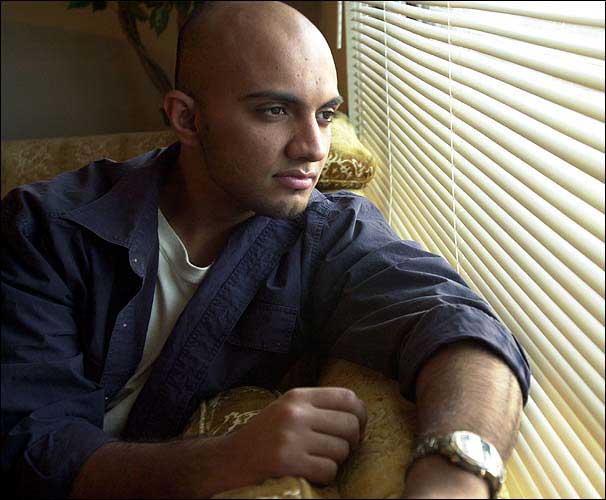
Adnan Chaudhry, a Kansas University senior from Pakistan, is one of the foreign students affected by a new U.S. government policy requiring students from Pakistan and Saudi Arabia to report to the Immigration and Naturalization Service to be photographed and fingerprinted. Chaudhry says the policy invades his privacy.
In the second phase, students and visitors from Afghanistan, Algeria, Bahrain, Eritrea, Morocco, North Korea, Oman, Qatar, Somalia, Tunisia, United Arab Emirates and Yemen have until Jan. 10 to report.
It’s unclear how many students are affected by the new registration system.
“Everybody’s asking that, but at this point we’re not sure,” Heston said.
KU enrollment records for fall semester 2002 classes show 81 students from Saudi Arabia, eight from Pakistan, seven from Iran, four from Qatar, three from Oman, and two from Morocco.
Bahrain, North Korea and Yemen each had one. Afghanistan, Algeria, Eritrea, Somalia, Tunisia, United Arab Emirates, Syria, Libya and Sudan had none.
Heston is familiar with the criticism of those targeted .
“All I can say is the president of the United States has declared this to be a matter of national security,” Heston said. “And the attorney general has the legal authority to take these actions and has chosen to do so.”

 Fact Sheet on final rule implementing SEVIS
Though the fingerprinting, picture taking and questioning take about 20 minutes per student, it’s not unusual for students to wait in line for one or two hours.
“I tell people to come in Wednesdays, that seems to be the day when things are the least hectic,” Heston said. “Mondays are probably the worst.”
The INS Office, 9747 N.W. Conant Ave., Kansas City, Mo., is open from 7:30 a.m. to 2:30 p.m., Monday through Thursday.