

Welfare cuts strain family
Subsidy loss not part of unspoken deal between Baldwin household, state
Until last month, 11-year-old Ayla Vesecky’s special diapers cost taxpayers about $150 a month.
The diapers were part of an unspoken deal Ayla’s parents had with the state: The Veseckys wouldn’t put their severely handicapped daughter in a state hospital — a move that would easily cost taxpayers more than $100,000 a year — and the state would help them keep her at home.
The Veseckys, who live in Baldwin, have kept their part of the bargain. But the state, it appears, is waffling.
Ordered by then-Gov. Bill Graves to cut $26.6 million from its budget, the Department of Social and Rehabilitation Services dropped the diaper subsidy, saving about $70,000 a month statewide.
On Jan. 10, the Veseckys — she runs a tanning salon, he’s a mechanic at Heritage Tractor — were told they would have buy their own diapers.
The Veseckys were one of 513 Kansas families receiving the diaper subsidy.
“We were barely making it with the subsidy,” said Joanna Vesecky, 31. “I don’t know what we’ll do because at the end of the month, we don’t have $150 sitting in the bank.”
Besides Ayla, the Veseckys have three other children, ages 6, 4 and 2.
Discount deal
Ayla was born with Nonketotic hyperglycinemia, a rare genetic disorder that causes mental retardation.
“It’s a terminal condition,” Vesecky said. “Every day is a gift — that’s the way we see it.”
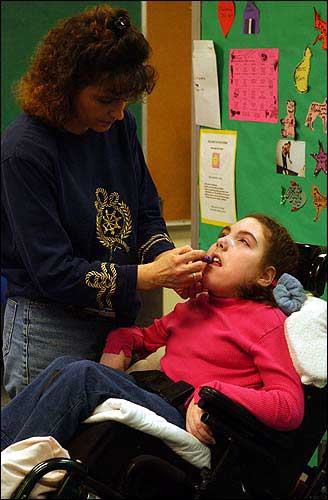
Joanna Vesecky does nearly everything for her 11-year-old daughter, Ayla, who suffers from a rare genetic disorder that causes mental retardation. A cut in a state subsidy that helped pay for diapers for Ayla is requiring the Veseckys to spend an additional 50 a month -- money they find difficult to come by. On Tuesday at Baldwin Elementary, Joanna applied lip gloss to Ayla's chapped lips.
At SRS, Laura Howard, assistant secretary in charge of health care policy, said the decision to cut the diaper subsidy was both regrettable and unavoidable.
Still, she said, the decision was driven by concerns that other families receiving the subsidy — those caring for medically fragile babies or elderly, incontinent adults — could buy their diapers for less at a discount store.
Because the subsidy is subject to federal regulations, diapers must be purchased through a medical supply company that is Medicaid certified.
Typically, diapers from a medical supply company cost more than those from a discount store.
Discount store diapers might be all right for families buying standard size diapers, but Ayla, Vesecky says, is too big for the baby size, too small for the adult size.
“Believe me, we’ve tried Wal-Mart diapers and they don’t work — she goes right through them,” she said. “The last time we tried them, she went through four in 30 minutes.”
Vesecky said she cannot find diapers for Ayla for any less — with or without the subsidy — than through a medical supply company in Wichita.
Seeking help
Gov. Kathleen Sebelius has proposed restoring the diaper subsidy in the state’s 2004 budget, which begins July 1.

 SRS Web site
Until then, Howard said SRS was hoping “community partners” — a group that includes churches, civic groups, health departments and Boy Scout troops — would “come together to help families like (the Veseckys) with their immediate needs in the short term.”
If the subsidy is restored, Howard says SRS will explore ways to streamline its diaper purchases.
Vesecky welcomed Sebelius’ call for restoring the subsidy but winced at the idea of being expected to ask others for help.
“Asking for handouts — that’s just not something we’ll do,” she said. “I don’t mind helping people and I don’t mind being helped, but I’m not about to go over to my neighbor’s house and say ‘Would you mind buying Ayla’s diapers this month?'”
Vesecky added: “I guess I don’t understand why we pay all the taxes we do and then when we need something like diapers, that kind of help isn’t there. To me, that seems like putting money in the bank and then, when you go to take it out, they tell you it’s not there.”
Though Sebelius has proposed restoring the subsidy, legislators have yet to make their intentions clear.
No sure thing
“Restoration is by no means a done deal, absolutely not,” said Shannon Jones, executive director of the Statewide Independent Living Council of Kansas and spokeswoman for the Big Tent Coalition, a group representing 63 social service agencies.
Rep. Barbara Ballard, D-Lawrence, serves on the budget subcommittee charged with crafting the House’s response to Sebelius’ proposed budget. She said she’s been told not to propose additional spending unless she’s prepared to cut the budget somewhere else.
“Of course the problem is there is no place else to take it from,” Ballard said.
House Speaker Doug Mays, R-Topeka, said few legislators were willing to increase taxes to offset the cuts in social services.
“I’m not sure where we get the money, to tell you the truth. It’s got to come from somewhere, and there doesn’t seem to be much of a movement to raise taxes for that purpose,” Mays said.
That leaves the Veseckys wondering where they’ll get the money to pay for Ayla’s diapers. But for them, putting Ayla in one of the state hospitals or giving her up to foster care is not an option.
“Oh, no, we’d never do that,” Vesecky said. “We see Ayla as a little angel and that, in a way, God has put her here to test us — and that’s a test we’re not about to fail. I guess the politicians in Topeka can fail it if they want to, but we won’t.”