

New wine bars savor success
Trend revives Argentina's centuries-old wineries
Buenos Aires, Argentina ? Spanish monks in the 16th century introduced winemaking here, bent on colonizing the Americas while reticent to give up the Old World pleasures that could be wrung from some of the most fertile farmland on Earth.
While the history of Argentine winemaking dates back centuries, the wine bar is something new in a country whose bountiful grape harvest has languished in the shadows of fabled vineyards abroad, even though this vast South American nation has long been the world’s fifth-largest wine-producing country.
But today, Argentine wines are flourishing as a wave of wine bars — called “bares de vino” in Spanish — have taken off in this cosmopolitan capital of 13 million people.
Never mind that Argentina is experiencing its worst economic downturn in a century: Wine bars are booming. A country unable to import expensive vintages from abroad now features its own array of domestic reds and whites, many of them as inexpensive as $2 to $4 a glass.
Even the huge economic crisis has helped turn the tables.
“Such moments of crisis are the perfect time to do something different,” said Fernando Morlesin, who joined two partners last September in opening La Guarda, a brick-walled Buenos Aires wine bar that is one of several gaining in fame.
La Guarda is based on the cozy, European-style “enotecas” of Italy and France, where patrons can nibble on olives and savory cheeses at low-slung cafe tables while taste-testing the wines from a largely homegrown cellar.
Others offer indulgent gastronomical shows with lots of flash, blending wine, food and artful design in trendy establishments that serve sushi and other delights not normally found in this meat-and-potatoes country.
Even in the most upscale establishments, most Argentine wines range between $10 and $20 a bottle, the product of a currency devaluation that has made Buenos Aires one of the latest bargains.
Epicurean art form
Whatever the format, the customers keep coming. Many are young, professional Argentines between 25 and 40 with a growing appreciation of fine local wines and the means to pay for it.
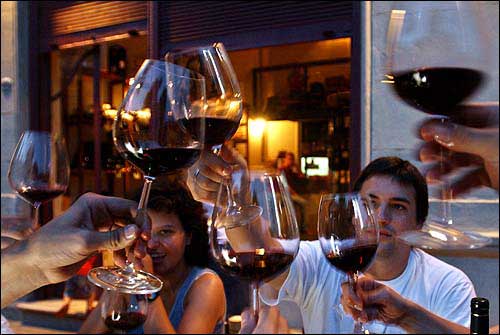
Although Argentina is experiencing its worst economic downturn in a century, its wine bars are booming. A country unable to import expensive vintages from abroad now features its own array of domestic reds and whites, many of them as inexpensive as to a glass. Here, friends toast at La Finca wine bar in Buenos Aires.
For example, take The Winery, which now boasts four Buenos Aires hot spots.
The Winery was the first wine bar to break new ground in Buenos Aires with a format that elevates local gourmet foods and wines to an epicurean art form, sealed into an all-in-one restaurant, cafe and wine store.
“Until The Winery opened, enotecas had a completely different style. We set the standard and continue to set the standard,” said Amelia Chemea, who at 26 is a successful entrepreneur and one of the owners of the 3-year-old wine bar.
Chemea, along with her two brothers, chose light-filled airy spaces, ambient music and minimalist furniture.
“When people enter, they feel like they are in New York, not Buenos Aires,” she said.
Buenos Aires wine bars are as unique as the local vintages they serve.
At the Gran Bar Danzon — the first to install a wall-to-wall wine bar — flickering candles and sleek leather sofas beckon patrons for a sip of Argentina’s finer vintages.
Five years ago, this wine bar would have been unthinkable.
“Before, drinking wine was something that you did at a neighborhood watering hole. It was looked down upon,” said Romina Righetti, a 28-year-old office worker, sipping an Argentine Cabernet from her perch on a comfy sofa. “But today there has been a huge change in the image of Argentine vineyards and there is this image of enjoying quality wines in crystal glasses.”
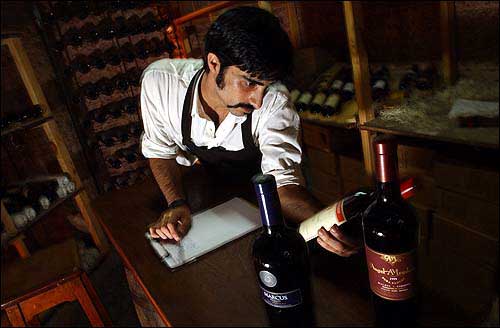
Daniel Frati studies a bottle of wine at the Enoteka wine bar in Buenos Aires. Enoteka has embraced homegrown wines since Argentina's peso currency collapsed last year.
The shift in local attitudes about wine has as much to do with improved grape quality as the emergence of the “boutique bodegas,” the equivalent of microwineries.
An influx of investment in Argentine wineries in the 1990s helped to convert production to higher-caliber varieties whose harvests now meet the demand of wine-savvy Argentines and foreign visitors alike.
“I have been to Chile and South Africa, countries that are known for their wines, and the quality of Argentina is equal or better,” exclaims Sven Vestjens, a 33-year-old Dutch traveler who was enjoying happy hour at a downtown wine bar with his pals.
Verdant valleys
Sommeliers and other wine tasters give high marks to Argentina’s quality varietals: robust reds like malbec, cabernet sauvignon and merlot, as well as demurely aromatic whites produced from chardonnay and torrontes grapes.
Such varieties thrive in the rich soils blanketing the western Argentine province of Mendoza, a Mediterranean-like oasis straddling the foothills of the Andean backcountry some 650 mile northwest of Buenos Aires.
Set against the backdrop of the majestic, snowcapped mountains, the province is home to more than 1,500 vineyards that picturesquely fan out across verdant valleys. They produce 90 percent of Argentina’s wine.
“Argentine wines are coming into their own style, with a lot of color, body and aroma,” said Aldo Graziani, the 31-year-old sommelier who oversees the 180 locally grown wines at Gran Bar Danzon.
Yet, because few local producers are exporting as they would like in the current crisis, 90 percent of this new class of Argentine wines has been left out of the reach of international consumers — and kept for domestic drinkers to savor.
“Thanks to Argentine wineries, a culture of fine wine drinking has emerged in the country,” said Andrea Montero, a 26-year-old who meets regularly with girlfriends to sample wines.
Enoteka, an inviting wine bar in the historic San Telmo district, is one showcase for old and new local vineyards.
Housed in a century-old building, Enoteka was launched in October 2001 with its climate-controlled cellar half full of pricey imports. But that was before the bruising devaluation made buying French champagne and Italian reds prohibitively expensive.
“Our original idea for the store has been changed, but now we pay more attention to Argentine wineries,” said Juan Carlos Hernandez, one of Enoteka’s three partners. He said sales had grown steadily despite hard economic times, partly fueled by foreign tourists snatching up local vintages at a bargain.
Now 95 percent of its 300 wines are Argentine — as well as the olives, cheeses, smoked meats and sweets.
As long as new quality Argentine wines keep being launched and their undervalued prices prevail, there seems no stopping the conquest under way by local vineyards — and the wine bars that are serving them up.
| Lodging: From five-star hotels to hostels, accommodations in Buenos Aires go the gamut. In central neighborhoods, it is not unusual to find a cheap night’s stay next to a luxury hotel. Because of a steep currency devaluation, comfortable, modern mid-range hotels can be had at less than $50 per night. See www.hotelsargentina.com for lists, prices and availability. Also, the city government provides information at www.buenosaires.gov.ar/areas/turismo/en.Wine shops: Because bacchanal-loving Argentines drink more wine per capita than Spaniards and Americans, finding a good offering from the vineyards is as easy as stopping in a local supermarket. Try Coto, Disco and Norte for fair-priced reds and whites, ranging from $2 to $22.For rarer vintages and higher-end wines, the wine shops or “vinotecas” scattered throughout the European-style city demand a visit. Ligier (www.ligier.com.ar) and Tonel Privado (www.tonelprivado.com) are the better-known stores. |