

Budget cuts threaten quality of legal representation for poor
Legislation could restore funding from Kansas Board of Indigent Services
Lawrence attorney Martin Miller is trying to get ready for a murder trial. He needs an investigator.
But he may have to do his own investigating.
Because of a state funding shortage, Miller and other attorneys who represent indigent criminal suspects may find it hard to line up private investigators and expert witnesses to testify. Payments from the Kansas Board of Indigent Services stopped Feb. 1.
“It’s an issue for appeal if he’s convicted,” Miller said, referring to Michael W. Kesselring, a Topeka man charged with first-degree murder and kidnapping in a drug case. The issue would be that resources weren’t available to provide Kesselring an adequate defense, Miller said.
Kesselring is scheduled for a trial March 3. Attorneys statewide who regularly handle indigent defense cases know they might have to do some investigating themselves, Miller said.
“But some of it I can’t do,” Miller said.
Because of the state’s financial crunch in meeting the remainder of the fiscal year 2003 budget, $550,000 was taken from the Board of Indigents’ Defense Service death penalty defense unit. Also taken from the board’s funding was $1.24 million slated for paying attorneys who handle indigent defense cases, their investigators and their expert witnesses.
In the Kansas Legislature, however, the House and Senate have passed differing versions of a bill that would restore that funding to indigent services.
The funding restoration measure was placed in bills that concern other unrelated issues, and it is the other issues where differences need to be worked out, said Sen. Stephen Morris, R-Hugoton, chairman of the Ways and Means Committee.
A conference committee meets today to try to iron out the differences so the same bill can be passed by both houses.
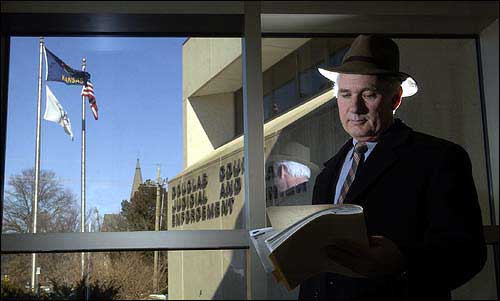
The lack of state funding for attorneys who represent indigent clients is keeping Lawrence attorney Martin Miller from hiring a private investigator in a murder case. On Friday, Miller reviewed case files in the Douglas County Judicial and Law Enforcement Center.
“I hope we can get this done quickly,” said Morris, who wants the funding restored.
If funding is not restored, problems facing court-appointed attorneys representing the indigent also could be a problem for prosecutors.
Not only would prosecutors have to contend with defense attorneys’ arguments that an adequate defense couldn’t be provided, but if there are continuances, long delays would make it harder to locate witnesses and bring them in to testify, Douglas County Dist. Atty. Christine Kenney said.
Cecilia Wood, a Lawrence private investigator, will accept less work from attorneys representing the indigent because she won’t get paid until the funding is restored. A majority of her cases are for private pay, but she has worked an average of two cases a month, and sometimes as many as four, for indigent services attorneys.
“If I take one of those cases, then I have to increase my private cases to make up for it,” Wood, a former Lawrence Police officer, said.

 Bill would halt death penalty for two years (2-4-03)
State pay for assisting the indigent isn’t lucrative for private investigators or attorneys. The state pays investigators $20 an hour, or less than a third of Wood’s regular private pay rate, she said.
Investigative work on death penalty cases increases to $50 an hour, said Wood, who handled some investigative work in Johnson County’s John Robinson case.
Attorneys for the indigent are paid $50 an hour, considerably less than what attorneys typically make from private pay cases. They get paid only for half an hour for some court hearings, such as trial settings and arraignments, even if they end up waiting an hour for their case to be called during docket call.
The pay rate for the indigent defense attorneys was established by the state in 1988. It has not increased since, despite increases in the costs of doing business, attorneys said.