

U.N.-Iraq talks ‘not last chance’ for peace
Disarmament officials call Saturday meetings with Iraqis 'useful'
Baghdad, Iraq ? With a shadow of war on the horizon, U.N. disarmament chiefs faced their Iraqi counterparts Saturday in “useful” and “very substantial” talks to finally get answers to questions about anthrax, VX and other forbidden arms from the past.
After more than four hours of meetings, U.N. nuclear watchdog Mohamed ElBaradei reported the Iraqis had presented unspecified “explanations on some of the issues.” The discussions resume today.
The talks were pivotal, but they were “not the last chance” for peace, ElBaradei said, clearly seeking to counter talk in Washington that the time for diplomacy had all but run out.
ElBaradei and chief U.N. arms inspector Hans Blix were looking for quick Iraqi concessions on practical matters in the disarmament effort here, such as clearance to fly American U-2 reconnaissance planes in support of their inspections.
They also were hoping to ensure that meetings continue with weapons scientists in private. Another scientist submitted to an interview Saturday — the fifth in three days — signaling a possible breakthrough on this issue.
But they also wanted more: Documents, testimony or other evidence to clear up discrepancies in Iraq’s accounting for weapons of mass destruction produced and weapons destroyed over a decade ago.
“If they don’t have the orders (to destroy weapons), if they don’t have the paper, give us the people who were involved, to talk to,” one U.N. delegate said before the first meeting in a Foreign Ministry conference room above a boulevard dotted with heroic statues of President Saddam Hussein.
The first round of talks opened just after 4 p.m. Saturday with a scheduled hour of high-level discussion between Blix, ElBaradei and Lt. Gen. Amer al-Saadi, a Saddam Hussein adviser and head of the Iraqi delegation. More than three hours of a full meeting between delegations followed.
Afterward, Blix told reporters, “It is useful discussions we are having. … It was a very substantial discussion.” But neither he nor ElBaradei provided any details of what “explanations” the Iraqis offered.
Another senior U.N. official, speaking on condition of anonymity, said the Iraqis had presented documents but they would have to be studied before inspectors could determine their value. He declined to say how many were handed over or to specify their subject matter. No Iraqi officials spoke with reporters afterward.
The two days of Baghdad talks will shape the reports the chief inspectors must present Friday to the U.N. Security Council, whose member nations are searching for unanimity on the next step in the explosive crisis.
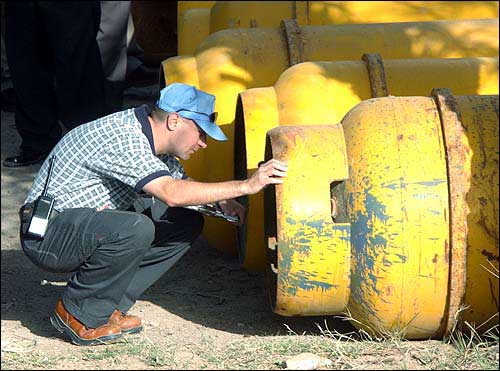
A U.N. weapons inspector checks a tank, thought to contain chlorine, at al-Rashid station for water purification in Baghdad, Iraq. Chief U.N. weapons inspectors Hans Blix and Mohamed ElBaradei, chief of the International Atomic Energy Agency, arrived Saturday for a second round of talks in Baghdad aimed at winning Iraqi compliance with the U.N.'s ban on weapons of mass destruction.
The council majority wants something short of a U.N. authorization for war against Iraq, sought by President Bush and British Prime Minister Tony Blair.
The U.S. and British governments contend that Iraq retains chemical, biological and nuclear weapons programs prohibited by U.N. resolutions, and threaten a military strike if not satisfied Saddam has disarmed.
In the central Iraqi city of Tikrit, Saddam’s hometown, thousands of soldiers and civilian militia members — women and older men among them — marched in a display of readiness for any U.S. attack, holding Kalashnikov assault rifles aloft, carrying outsized portraits of Saddam.
Against this talk of war and peace, the more than 100 U.N. inspectors went about their daily business in Iraq. Inspectors paid surprise visits to industrial sites and a technical institute, and a nuclear team surveyed parts of Baghdad with a vehicle monitoring for radiation.
The Iraqi Foreign Ministry said one U.N. team cordoned off an area in Baghdad for four hours Saturday and searched a printing plant, a military factory and a kindergarten.
U.N. officials were not immediately available for comment.
Also Saturday, coalition aircraft dropped 480,000 propaganda leaflets over southern Iraq, warning civilians to stay away from areas occupied by the military and giving a radio frequency in which they could listen to information explaining U.N. activities in Iraq.