

A tale of two gifts from the heart
Grandmothers enjoying life thanks to generosity of organ donors
Walnut Creek, Calif. ? For most of us, time rolls by unexamined, days unraveling one into another, until we bump into something — a landmark birthday, a childhood friend — and startle, wondering what happened to all those years.
But it’s not like that for Linda O’Hara. Ever since the day her sister saved her life, she finds that even ordinary events are filled with a meaning that can’t be ignored.
“When I play with my new grandson, Kyle, I sometimes weep with joy at the thought that Beverly gave me life so I could be here for him and my daughter, Heather,” she once wrote.
It’s been 16 years now — and still, she struggles to explain the depth of her gratitude.
Hitting a wall
Linda’s surprising story begins back when she herself was a new mom, with a young son and daughter to care for. First came a series of terrible headaches, and then the doctor’s startling, devastating diagnosis: Linda had inflammatory kidney disease, glomerulonephritis, probably the result of childhood bouts with strep throat.
There was no cure, but there was hope, he said: The disease progressed slowly. If she took care of herself and ate right, Linda could go as long as 15 years with no major consequences.
The doctor was right: Linda monitored her diet, refrained from drinking, got lots of exercise. And exactly 15 years later, she hit the wall. Her kidneys failed.
She got very sick, very quickly. The toxins that weren’t cleaning out of her body had begun to affect her brain, causing her to lose her memory and become confused. She began dialysis but remained exhausted and started shedding weight.
Eight months after Linda began regular dialysis, her older sister came to visit.
Beverly Cass, a registered nurse, was shocked by what she saw: Her sister — who always presented such an upbeat assessment of her health — weighed only 96 pounds. She was listless and lethargic, too sick to even take a shower.
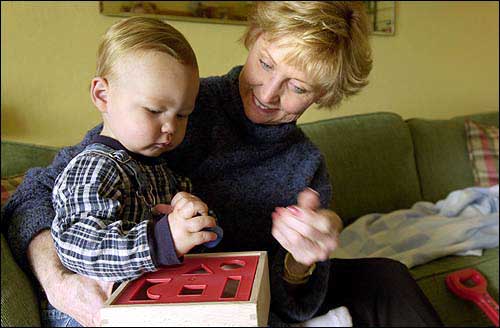
LINDA O'HARA savors ordinary events, such as time spent with her grandson, one-and-a-half-year-old Kyle Schomaker. O'Hara received a kidney donation from her sister, Beverly Cass, 16 years ago.
“She looked like she was dying, which she was,” remembers Beverly, who now lives in Yorba Linda. “I could see she wasn’t long for this world the way she was going.”
That’s it, she declared: You’re taking my kidney.
Linda hesitated to accept, knowing what an ordeal her sister would have to endure.
But she knew, too, that she was running out of options.
Feeling normal
A simple blood test determined that they were a match. And just a few months later, on Jan. 13, 1987, both sisters were wheeled into surgery at UC San Francisco. It took surgeons five or six hours to cut into Beverly’s ribs, remove one of her kidneys and insert it into her sister’s body.
For Linda, everything changed. “I felt better immediately. As soon as I woke up, I could think clearly.”
Beverly, on the other hand, was suffering. The first three days were the worst, she says — she couldn’t move from the bed. She was able to fly home to Southern California 10 days after the surgery, and took the next three months off work to recover. (These days, kidney donors benefit from a much less invasive “keyhole” surgery.)
Other than a 4-inch scar, Beverly, now 65, has suffered no lasting effects. “I forget that I only have one kidney,” she admits.
Linda, who now lives in Danville, Calif., continues to monitor her health closely. She visits the gym every day, watches her diet, and takes a cocktail of medications to ensure the body will not reject her sister’s kidney.
| Roughly every 90 minutes, someone in the United States dies waiting for an organ transplant.In recent decades, improved medical science and better anti-rejection drugs have dramatically increased survival rates for transplant recipients.Among those who get new kidneys, for instance, more than 80 percent are still alive five years later. Other organ recipients have similar five-year survival rates: 84.1 percent of those who receive a pancreas, 75 percent who get a liver, 69.6 percent of those with a new heart.Here are some other facts on transplants:¢ The waiting list for organs includes 80,754 people in the United States.¢ In 2001, 6,000 people died waiting for transplants.¢ Living donors give about half of all transplanted kidneys, and about a quarter of all transplanted livers (only a portion of the liver is removed).¢ Organs are not harvested from deceased donors unless the person has been declared brain-dead by two physicians unrelated to the transplant surgeons.¢ Even if you filled out a donor card, your organs will not be used without your family’s consent. But in all cases of brain death, the law requires that an organ procurement agency ask the next of kin to decide about donation. That’s why it’s important to tell your loved ones now about your wishes.¢ One person can donate seven life-saving organs.¢ Most religions support organ donation as an act of compassionate charity. |
For the past 16 years, she’s been feeling normal — a state she’s learned to sincerely appreciate.
Today, Linda serves as president of Bay Area TRIO, a support group for transplant recipients. Much of her work surrounds educating people about organ transplants and how effective they can be.
Each year, the two sisters spend Linda’s “transplant birthday” together. One year, it was a vacation to Hong Kong; these days, it’s usually a visit to the spa.
Throughout the year, whenever the mood strikes, Linda sends a card or a letter to her sister, just to say thanks.
“I try to bring it up. I don’t ever want her to forget how much I appreciate the gift she gave to me. She gave me life. You can’t repay that gift with anything.”
Lightning strikes twice
That’s not the only happy ending in this story, though.
Five years after Beverly donated her kidney, her daughter gave birth to a boy.
From the moment he took his first breath, Mitchell faced a grave struggle to survive.
The left side of his heart didn’t work. Beverly’s daughter, Lori, was given two choices: She could take the little boy home to let him die, or they could put him on the transplant list.
It was no choice at all.
For three agonizing weeks, the family waited to find out whether Mitchell would get a second chance at life. Then one day, they were told of a little girl in Oklahoma City who swallowed a marble, cut her windpipe, and died, leaving behind a heart still young enough to fit inside Mitchell’s tiny body.
Today, Mitchell is 11 years old. He plays the clarinet, loves to read Harry Potter books and is at the top of his sixth-grade class.
“He gets straight As,” says his proud grandma. “He’s just a real good kid.”
Linda and Beverly don’t dwell on the fact that lightning hit their family twice. Just the luck of the draw, they say, if you can call that luck.
Both tell their stories matter-of-factly, but someone hearing it for the first time can’t help but marvel at the mysterious circularity of it all: two sisters, two organ transplants, two grandmothers now able to enjoy every ordinary day with their grandsons.
Their story begs the listener to ask larger questions. Was Beverly’s selfless donation connected, somehow, to the fortuitous arrival of Mitchell’s heart?
When asked, Beverly sounds genuinely surprised.
She has really never thought of it that way.