

Drug industry faces hurdles despite Medicare reform bill
Canadian, generic drugs affecting firms' profits
New York ? Pharmaceutical company executives breathed a collective sigh of relief when the Medicare reform bill excluded two ideas they abhorred: imports of low-priced drugs and government price controls.
Industry lobbyists had swarmed the capital before the bill’s late-year approval, pressing aggressively against both measures. They emerged victorious — but it doesn’t mean they can relax. The issue of prescription drug costs will rage into 2004.
No sooner did the reform pass than the movement for legalizing imports from Canada gained some key new allies, including the state of New Hampshire and the city of Boston, which have plans to bring in drugs for public employees.
At the same time the drug industry has other headaches: including generic competition, sluggish development of new drugs and consumer demands for ever-deeper discounts.
“The industry is in for a tough couple of years,” said Henry Grabowski, director of the program in pharmaceuticals and health economics at Duke University.
Some big pharmaceutical companies are tightening up on supplies to Canada, trying to squelch the increase in purchases of Canadian drugs by Americans on bus trips, through storefronts and on the Internet. Canada’s government controls drug prices, which are up to 50 percent cheaper than they are in the United States.
States’ fight restrictions
The states aren’t standing for it.
Illinois Gov. Rod Blagojevich has announced a plan to remove from the state’s list of preferred drugs any products made by companies that limit supplies to Canada, if a safe equivalent is made by another company.
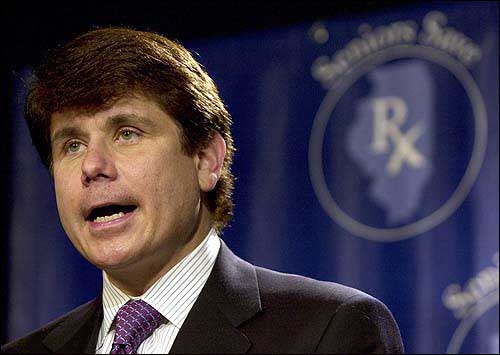
Illinois Gov. Rod Blagojevich announces a plan to remove drugs, from drug companies that are limiting their supplies to Canada, from the state health plan's preferred list in Chicago. He made the announcement Nov. 25.
The U.S. Food and Drug Administration and the Department of Health and Human Services call importation illegal and unsafe, but states are trying to find a way to save money for public employees and residents.
A new Medicare drug benefit doesn’t take effect until 2006, but seniors can purchase a discount card in 2004 that will slice 15 percent to 20 percent off the cost of their medicines. Opponents of the reform say buying drugs from Canada will remain a better deal, and popular.
Cards will be sponsored by various organizations ranging from drug chains to AARP to pharmacy benefit managers so discounts will vary.
“The program is just so confusing and it doesn’t bring real savings.” said Dee Mahan, a senior policy analyst with Families USA, an advocacy group that is very critical of the pharmaceutical industry.
Firms’ profits waning
These days drug companies need all the sales and profits they can muster. Profits in 2003 are expected to grow by an average 6 percent, which is an improvement from the 1 percent increase in 2002. But it’s still far short of the mid-teens growth in the late 1990s.
According to Thomas First Call, industry profits should pop back up to 13 percent next year, but some of that may come from cost-cutting measures. For example, earlier this month Schering-Plough Corp. said it would slash at least 10 percent of its payroll, or perhaps 3,000 jobs. Merck & Co. announced earlier this year that it was laying 4,400 people, about 7 percent of its work force.
Since February, Merck has pulled the plug on four drugs it had been testing, highlighting the industry’s problem in getting new drugs through the development pipeline to replace ones losing patent protection.
“Research and development is cyclical, and in the last three year or so year, the trend has been toward introducing fewer drugs,” Grabowski said. “It is worrisome.”
Two of the new year’s most anticipated drugs are cancer treatments made by biotech companies, not big pharmaceutical companies. Avastin is made by Genentech Inc. while Erbitux was discovered by ImClone Systems Inc. Bristol-Myers Squibb Co. owns 20 percent of ImClone and will share in the drug’s profits.
Generic drugs on rise
Earlier this year, Bristol-Myers said $1 billion in revenues annually will evaporate during the next few years because of generic competition, and its newer, pending products don’t carry the same high profit margins.
Indeed, generic companies are becoming more aggressive in challenging drug company patents and they are winning. GlaxoSmithKline lost patent challenges on two of its major drugs within the last 18 months. This year, Pfizer Inc. and Eli Lilly Co. face patent challenges on some of their best sellers.
“The generic companies have scored some victories and have become bolder,” Grabowski said.
At the same time, insurers and employers are pushing consumers to use generic drugs by continuing to raise co-payments on medicines.
Higher co-payments have moved some to stop filling prescriptions and the uninsured often forgo drugs because they can’t afford them. According to the research firm IMS Health, the number of prescriptions dispensed from January through Oct. 3, grew 2 percent, compared with 5 percent in 2002 and 6 percent in 2001.
What’s more, the federal government may change its position on price controls should costs associated with the Medicare drug benefit spiral out of control.
“Medicare legislation doesn’t close all of the issues in the industry,” Tusk said.