

Warming effects threaten ski slopes
Turin, Italy ? Global warming is threatening the world’s ski resorts, with melting at lower altitudes forcing the sport to move higher and higher up mountains, according to a United Nations study released Tuesday.
Downhill skiing could disappear altogether at some resorts, while at others, a retreating snow line will cut off base villages from their ski runs as soon as 2030, warned the report by the U.N. Environment Program.
“Climate change is happening now. We can measure it,” said Klaus Toepfer, executive director of the U.N. program. “This study shows that it is not just the developing world that will suffer.”
The report focused on ski resorts in Austria, Italy, Switzerland, Australia, the United States and Canada, using temperature forecasts produced by the Intergovernmental Panel on Climate Change, a body of some 2,000 scientists.
The panel estimated temperatures would rise by a range of 2.5 degrees to 10.4 degrees Fahrenheit by 2100 unless dramatic action were taken to reduce greenhouse gas emissions.
Many scientists believe that carbon dioxide and other so-called “greenhouse” gases trap heat in the atmosphere.
“It appears clear that many resorts, particularly the traditional, lower altitude resorts of Europe, will be either unable to operate as a result of lack of snow or will face additional costs, including artificial snowmaking, that may render them uneconomic,” the report said.
U.N. officials presented their findings at an environmental conference of the International Olympic Committee, or IOC, hosted by organizers for the Turin 2006 Olympics.
The findings prompted Pal Schmitt, head of the committee’s Sport and Environment Commission, to say that global warming will “probably affect how the IOC chooses host cities for future Winter Games.”
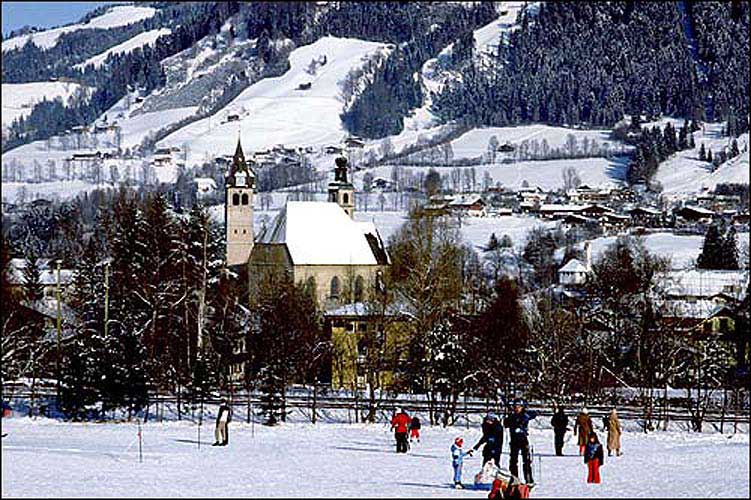
The Austrian mountain resort of Kitzbuhel, which is 2,493 feet above sea level, will eventually be cut off from its ski slopes, according to a report by the U.N. Environment Program. According to the report, issued Tuesday, global warming will put many of the world's ski resorts at risk. The report warned that melting at lower altitudes would force the sport to move higher up in the mountains.
Schmitt said that the IOC still prefers new candidate cities, but it may be forced to return to sites of recent games to avoid having to build structures that could be obsolete in the near future.
The magic number for ski resorts right now is an altitude of 4,265 feet, according to Rolf Buerk, an economic geographer at the University of Zurich who led the research behind the report. At that level and above, there is reliable snowfall. In the future, however, global warming is going to push the regular snowfall altitude to between 4,900 feet and 6,000 feet, Buerk said.
One likely casualty is the scenic Austrian village of Kitzbuhel, Buerk said. The village is 2,493 feet above sea level and eventually will be cut off from its ski slopes. That’s because, according to the report, Austria’s snow line is expected to rise by 656 to 984 feet in the next 30 to 50 years.