

Painted vases fetch high prices
Art pottery is probably the most popular collectible seen at shows and shops today. Samuel Weller opened a small pottery in Fultonham, Ohio, about 1873. He made unpainted flowerpots and other plain wares. He soon found that by decorating the pots with house paint, he could sell them to housewives in nearby Zanesville. His firm flourished, and he moved into larger and larger plants, still making painted flowerpots, jardinieres, hanging baskets, umbrella stands and other pottery.
In 1893, he built an addition onto his plant, and he soon started to make art pottery. By 1915, Weller Pottery was possibly the largest art pottery in the world. The company prospered and made all forms of ceramics until 1948, when it went out of business. One of the pottery lines made in the 1920s and ’30s was called Coppertone. It had a blotchy green glaze over a brown glaze that resembled patinated copper. Many of the pieces were decorated with frogs, fish or plants. Prices for Coppertone have gone up in the past few years. A vase of the same design as one that sold for about $425 in 2000, recently sold for $4,025.
I would appreciate any information you can give me about a small trestle table I inherited from a friend. It is 26 inches long, 12 inches wide and 24 inches high. The sides are closed and carved with scrolls and leaves. There is a flat, open shelf a few inches under the tabletop, and there’s a V-shaped shelf near the bottom. The sticker on the bottom reads “Imperial, Grand Rapids, Mich.”
Tables like yours are often called bookstands. The V-shaped shelf can hold several books, and the flat shelf is designed to hold a few favorite volumes close at hand. The bookstand was manufactured by the Imperial Furniture Co., which operated in Grand Rapids from 1903 to 1954. Your bookstand probably dates from the 1920s or ’30s.
For more than 60 years, I have had two 34-inch paper dolls. One is Shirley Temple, and the other is a little girl with curly blond hair, brown shoes and blue overall shorts. Each doll has five outfits with paper tabs. I no longer have the original boxes, and both the dolls and clothes have been cut out. I have never seen these paper dolls at shows or sales. Can you tell me what they’re worth?
Collectors prefer boxed paper-doll sets that have never been cut. Your Shirley Temple set — the more valuable one — was issued in 1936 by the Saalfield Publishing Co. of Akron, Ohio. Saalfield had exclusive rights to produce Shirley Temple publications, including paper dolls. Your other life-size doll was designed by Queen Holden, a commercial artist, for the Whitman Publishing Co. of Racine, Wis. Your large paper dolls were advertised as “life-like.” If your dolls were uncut and mint, Shirley would sell for about $150. Your cut doll is valued at about half that. The other paper doll, uncut, is worth about $40. Yours would sell for about half as much. Reprints of both paper-doll sets have been made.
Fifty years ago, a friend of my mother’s gave her a large, metal sphinx-shaped candlestick. The friend had bought it at a pawn shop in Providence, R.I. It is about 18 inches long and 12 inches tall. The sphinx is stamped “Frank Daniels Comic Opera Co.” on one side and “The Wizard of the Nile” on the other. The bottom is marked “N. Mullers Son & Co.” Can you give me any idea about the history of the candlestick?
“The Wizard of the Nile” is an American comic opera. It was written in 1895 by Victor Herbert, with words by Harry Bache Smith. The opera was composed specifically for a well-known comedian of the time, Frank Daniels. N. Mullers Son & Co. must have cast the metal sphinx. Perhaps the sphinx candlestick was a prop for the set. Or it might have been cast as a memento for Daniels or other actors in the opera.
I inherited some old tools from my grandmother. There’s one I can’t identify. It’s T-shaped and about 3 3/4 inches long. The stem is an inch wide at the bottom, with a recessed hole that’s 5/16-inch square. The top of the T is the handle. The stem is embossed “The National Casket Co.” Can you tell me what this tool is and when it was made?
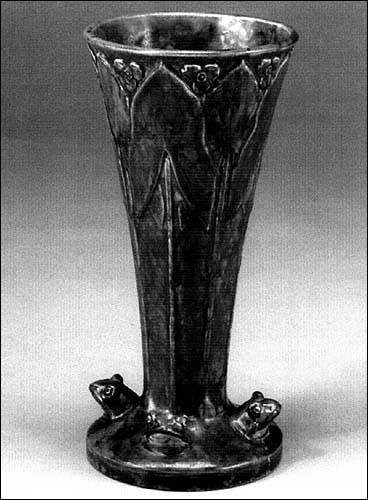
this rare 12-inch-high weller Copperstone vase with frogs and lily pads sold for ,025 at a recent David Rago auction in Lambertville, N.J.
Your tool is a casket key, a small crank-style wrench that locks a casket. The National Casket Co. was in business in Oneida, N.Y., from 1860 until 1960. Casket keys sell for a few dollars at flea markets and on the Internet. You now have to solve the mystery of why your grandmother had a casket key.
| Current prices are recorded from antiques shows, flea markets, sales and auctions throughout the United States. Prices vary in different locations because of local economic conditions.¢ Donald Duck book, “Bringing Up the Boys,” 1948, Whitman, $75.¢ Aunt Jemima Pancake Flour puzzle, cardboard, die-cut, premium, “Send 4 cents for life history of Aunt Jemima & her Pickaninny Dolls,” 1910, 3 x 5 inches, $125.¢ Satsuma pottery vase, cherry-blossom design, beige-and-gray honeycomb field, gilt border, 18 inches, $275.¢ Folk art walking stick, single-piece hardwood, knob carved in form of man’s head with hat, 29 3/4 inches, $290.¢ Carrie Nation hatchet, cast iron, inscribed “All Nations Welcome but Carrie,” portrait of Carrie on blade, 11 inches, $460.¢ Hooked rug, wool, maple-sugar harvesting, 3 figures, cabin, woods, sap buckets on trees, oxen, black border, neutral colors, 29 x 44 inches, $940.¢ English Delft double-gourd vase, paneled neck and foot, blue-and-white floral arabesques ground, ocean wave on foot, 1720-1750, 10 3/4 inches, $1,090. |