

Ready to roll
You can dust off an old bike or buy a new one, but expert say comfort is key to staying mobile
Longtime cyclists have heard the excuses.
They know people believe bicycles are too expensive, too dangerous, too uncomfortable and require too much effort. They know nonriders hate steep hills, fast cars and those funny-looking helmets. They know your last bike ride left your legs, back and butt sore for days.
But cyclists also know your secret desires.
They know you want to be healthy, fit and strong. They sense you envy those laughing bicycle riders who pedal through scenic countrysides and then sit down to a four-course lunch. They know that the green eco-gremlin lurking deep inside you makes you yearn to burn calories instead of gasoline.
The solution: Live your dreams. Forget about finding the right route, the perfect moment or bicycle shorts that don’t make your butt look big. Just dust off that old Schwinn and start pedaling toward a better tomorrow.
And don’t worry that the bike you’re riding might draw sneers from triathletes in training.
“Whatever you have, take it to the bike shop and have it set up for what you want to use it for,” suggested Jason Wennstrom, manager of Rainier Cycle Sports in Tacoma, Wash.
“It’s not about the bike. It’s about cycling — having the bike become part of your lifestyle,” Wennstrom said. “If you have a bike in the basement, pull it out — we’ll put some air in the tires — and go ride.”
Comfort bikes
For would-be riders without a bike in the basement, a return to cycling usually starts with a trip to a bicycle dealer. There, newcomers often face a head-spinning assortment of high-end bicycles that can cost more than some used cars.
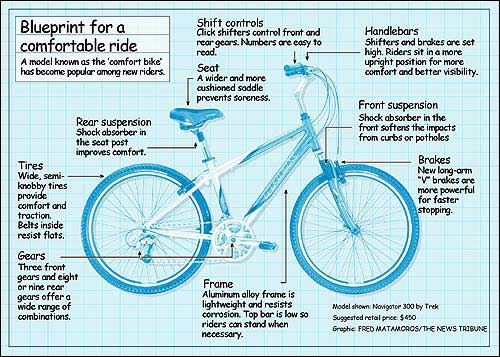
Wennstrom is happy to sell high-end bikes. But new riders often are drawn to what manufacturers call the comfort bicycle, a beginner-friendly style Wennstrom calls “the sports utility bike” of the modern market.
Comfort bikes feature a padded saddle, high handlebars and easy-to-use shifters that click with each gear change. A shock absorber in the seat post, two shocks on the front forks and big, wide tires cushion the rider on rough surfaces.
The frames’ top bar sits low, making it easy for riders to stand or dismount.
“It offers more comfort than you need, and it’s what everybody wants,” Wennstrom said.
Getting what you pay for
Most models sold in bike shops start around $300.
In exchange for extra comfort, riders get a bike that’s heavier and slower than the sleek, lightweight models designed for long tours.
Close cousins to comfort bikes are cross bikes or hybrids. These have the same bump-absorbing suspension systems of comfort bikes or low-end mountain bikes, but hybrids often feature slightly narrower tires, lower handlebars and frames with higher top bars.
Ralph Wessels, president of the Tacoma Wheelmen’s Bicycle Club, said new members often arrive pedaling cross bikes and hybrids but switch after a year or two as they grow more accustomed to cycling. Most step up to leaner road bikes that weigh less and go faster.
The lighter, faster bikes often start around $500, and high-end models can fetch $4,000 or more.
Prices rise as the manufacturers add expensive, lightweight frames, vibration-absorbing carbon-fiber forks or finely crafted gears and derailleurs for cleaner shifting.
Riders who have selected a bike model must also find one in the right size. Frames that are too long or too short can lead to pain in the shoulders, back and neck, Wessels said.
New riders also should expect to spend about $100 on accessories. Locks are recommended, and many areas have helmet laws.
Gloves, water bottles and padded bicycle shorts make riding more comfortable. Simple tools and a spare tube or repair kit carried in a pack or pouch will come in handy if a tire pops.
Many cyclists also buy new saddles to replace the seat that came with the bicycle. A variety of models are available in different shapes or with different levels of padding.
Wennstrom said he hears many people say they avoid bicycling because they worry about being hit by cars or getting hurt in falls. He believes they are missing the big picture.
“The No. 1 killer in this area is not riding a bike,” Wennstrom said. “It’s being sedentary.”
Health
Program that helped people with disabilities scrapped again
Margaret Tomlinson has been recovering from a traumatic brain injury for three years. Nearly a year ago, she moved ...
Excitement builds as LMH Health draws closer to completing Therapy Services renovations
More children’s hospitals turn to furry caregivers to help kids heal
Sometimes ‘baby blues’ is actually something darker
Moments after Jenna Carberg gave birth to her daughter, doctors put the baby on her chest. “I felt a disconnect ...
Moving to music offers all kinds of benefits as you age
Conflicting mamogram advice leads to confusion
WASHINGTON — Deciding when to get routine mammograms is confusing. Some health groups recommend women begin at ...