

Dated pop-icon collectibles often go unnoticed
Collectors buy antiques to use them or display them — and to remember the past. Many collectibles of the 20th century were inspired by characters or people in comic strips, books, vaudeville acts, theater, politics, radio, movies or television. Toys games and other objects that are meant for children, like candy containers, often picture comic characters. It is easy to identify Superman or Mickey Mouse. They are less than 75 years olds and are still popular. But a Palmer Cox Brownie, introduced in an 1883 book, or the Katzenjammer Kids, from an 1897 comic strip, are unrecognized by most people. A collectible has added value if the name and age of the character are known. It is possible to get a bargain character bottle or toy if you know more than the seller knows, so do some research. Ask older friends or relatives — and use the library.
Can you give me any information about the upholstered platform rocker we’ve had in our family for more than 100 years? I believe it was designed by Charles Eastlake. There’s a label on a brass plate attached to the bottom rung that reads “Pat. Jan. 19, 1875, Reissued Jan. 13, 1880, Streit and Schmit, Cincinnati, Ohio.”
Your Victorian platform rocker is also called a “patent rocker,” because its rocking mechanism was patented as a new invention. Patent rockers were first manufactured in the mid-19th century. The patent dates on yours indicate that it was made during the 1880s or ’90s. A furniture company called Streit and Schmit was in business in Cincinnati in 1889. C.F. Streit Manufacturing Co., probably a successor to Streit and Schmit, was operating in Cincinnati in the late 1920s, making upholstered lounge chairs called “slumber chairs.” Charles Eastlake was an English architect, artist and writer. He wrote a book about furniture styles that was widely read in the United States. Furniture makers here copied the styles pictured in his book.
What can you tell me about my old silver-plated tray? It has a border design of embossed grapevines and punched flowerpots. The back is marked “Coronet, Plate, E.P. Copper.”
Your tray was manufactured by the Coronet Silver Co. of Brooklyn, N.Y. Coronet was in business about 1950. “E.P. Copper” means that your tray is made of copper electroplated with a coating of silver.
I have a 9 1/2-inch figurine of two pink birds. The birds look like cockatoos. Each bird is perched on a large green leaf extending from a sandy-colored base. The bottom is marked “Stangl Pottery Birds, 3405D, VG-F.” What is it worth?
Stangl Pottery was in business in Trenton, N.J., from 1929 to 1978. It was most famous for its hand-painted dinnerware and bird figurines. The birds were first made in 1939. Your figurine is called “Double Cockatoo.” It was decorated by a painter named Vera Gordon (the VG initials in the mark), who worked at the company’s Flemington (N.J.) outlet store (the F in the mark). Shoppers at the outlet could watch some of the artists paint. The bird-decorating department was located in Flemington between 1942 and ’46, so your figurine dates from that period. It sells for about $150.
An antiques dealer in New Orleans gave me a china bowl about 40 years ago. It is white with red, blue, yellow and purple flowers and green leaves. The bottom is marked with a blue scroll that reads “Japan Opaque.” There is also a hand-painted number. Was this bowl made in Japan? How old is it?
Your bowl was made in England by one of the Ridgway potteries of Staffordshire, England. “Japan Opaque” is the name of the pattern. The bowl probably dates from the mid-1800s, or perhaps earlier. The design was transfer-printed onto the bowl, then hand-painted in several colors.
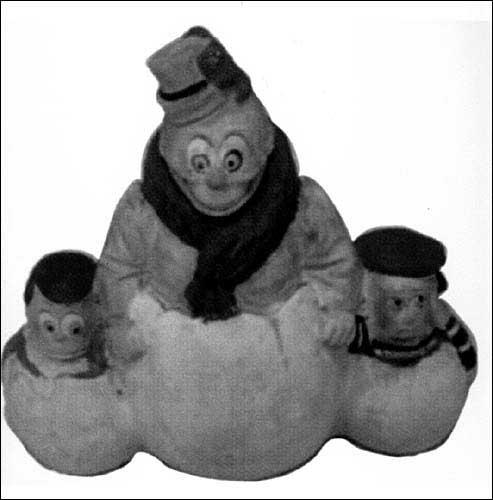
This comic-character candy container showing three figures on eggshells was auctioned recently. The composition container sold for 30 at Bertoia Auctions, Vineland, N.J. It might have been worth more if the character could be identified.
Tip
If the batteries in a toy have corroded, remove them and rub an emery board or steel wool on the contact points. Then put new batteries in the toy. It should work.
Current prices
Current prices are recorded from antiques shows, flea markets, sales and auctions throughout the United States. Prices vary in different locations because of local economic conditions.
- Political trivet tile, picturing President and Mrs. John F. Kennedy in the White House, metal, 5 x 8 inches, $30.
- His Perfume bottle, House for Men, glass, white plastic stopper shaped like square stylized face, bottle is a maroon enamel tuxedo, 6 1/2 inches, $125.
- Sterling-silver cocktail shaker, bubbled lid, curved spout, curved handle, impressed mark, Whiting, 1923, 9 inches, $355.
- Casey Jones doll, jointed, painted side-glancing eyes, red hair, freckles, denim engineer’s outfit, original box, 12 inches, $385.
- Toio floor lamp, brass stem, nickel-plated base, design by Achille Castiglioni, manufactured by Flos, 1962, 67 inches, $440.
- Art Deco rug, circular, stylized petals, magenta, brown, orange and yellow, 1935, 93 inches, $500.
- Lucky Tiger Hair Oil sign, cardboard, easel-back, blond woman and head of tiger with bottle of green liquid, 22 x 33 inches, $550.
- Stoneware jug, cobalt-blue stylized flower, egg shape, strap handle, Nichols & Boynton, Burlington, Vt., 1856, 18 inches, $940.
- Cut-glass dish, Carnation pattern, signed “Hawkes Gravic,” c. 1900, 12 inches, $2,950.