

Nutting furniture remains popular
Is it a fake, a fantasy or a modern fooler?
Copies of furniture from an earlier time have been made for hundreds of years. Today, some of the older copies have become valuable because of their craftsmanship and the fame of the maker.
Early-20th-century Nutting furniture is being sold in many shops and auctions. Wallace Nutting had been a practicing minister for 16 years when, in 1904, he retired and moved to a pre-revolutionary house in Connecticut, the first of seven houses he furnished and restored. It was there that he began making hand-colored photographs, now often called Nutting prints. Millions were issued from 1900 to 1941, and today serious collectors pay hundreds to thousands of dollars for a print. The record price is $8,910 for a picture called Mother Hen.”
But Nutting’s furniture was almost forgotten until about 10 years ago. He started collecting furniture for his home, used pieces in his photographs and in 1917 started making copies of his own collection. More than 500 different pieces were made, including Windsor chairs, oak cabinets, Chippendale-style desks and gateleg tables. The new furniture was branded with his name, so it would be easy to identify the pieces as copies.
Nutting died in 1941, and his furniture patterns were sold to Drexel Heritage Furnishings, which made a few Drexel-Nutting pieces in the 1950s and ’60s. Recent prices for Nutting furniture include $1,870 for a Hepplewhite-style double bed, $1,320 for a maple bench, $633 for a maple corner chair and $825 for a knuckle-arm Windsor — much less expensive than 18th-century originals.
In 1939, I had lunch at a well-known restaurant in Los Angeles called Bullock’s Tea Room. I saved the children’s menu, titled “Take a Bite with Snow White.” It’s red, white and blue, with pictures of Disney characters from the cartoon movie “Snow White and the Seven Dwarfs.” The menu, with a 1938 copyright date, is one piece of heavy paper about 12 3/4 by 9 1/2 inches. It folds twice to form the menu. Children could choose a “Snow White Luncheon” for 65 cents (creamed chicken or chopped steak) or a “Seven Dwarfs’ Luncheon” for 50 cents (scrambled eggs or cottage cheese with fruit). Does the menu have any value?
Disney’s classic animated film “Snow White and the Seven Dwarfs” was released in December 1937. Bullock’s was a department-store chain that was founded in Los Angeles in 1906. (Bullock’s stores became Macy’s stores in 1996.) The tea room in Bullock’s downtown Los Angeles store was a famous meeting place in the 1930s. Your children’s menu, licensed by Disney, is an unusual Disney collectible. Its value is difficult to determine. It might sell for $25 to a menu collector or for more than $50 to a Disney collector.
About 35 years ago, I was digging for old bottles in a dump near Sacramento, Calif. I found a small stoneware crock. I cleaned it and discovered that it was in excellent condition. My wife uses it as a holder for kitchen utensils. It is 5 1/4 inches tall by 4 3/4 inches in diameter, and it has a dark-blue line around it near the top. In a dark-blue rectangle on one side, the following phrase is printed: “When beating, think of eating Pure Food Groceries from ‘The Boys.'” What does “when beating” refer to?
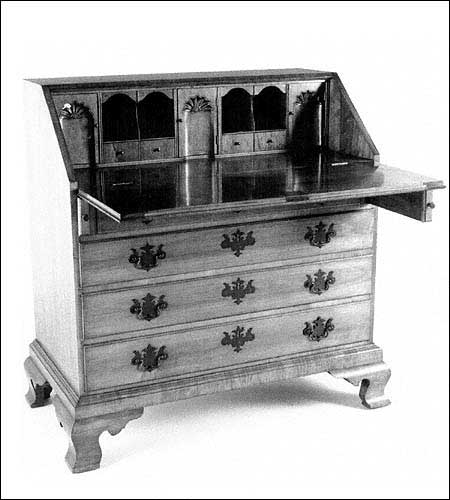
FURNITURE BY WALLACE NUTTING is interesting collectors. This copy of an 18th-century American Chippendale desk was made in the 1920s.
Your stoneware crock is a “beater jar.” Straight-sided beater jars were made for beating eggs, cream or salad dressing. We suspect that your jar was made by the Red Wing Union Stoneware Co. of Red Wing, Minn. Red Wing did not mark all of its small stoneware pieces. Check the bottom for a Red Wing mark, sometimes a drawing of a bird’s wing. Your crock was probably made around 1915. Red Wing sold many crocks like yours to grocery stores around the country. The stores sold the crocks, which were usually filled with jam, peanut butter or some other food staple. Pure Food Groceries was a brand name used by Montgomery Ward. It might also have been used by other retailers.
My Ives toy locomotive belonged to my grandfather — and I’m 71. It is dark green with red and gold trim. The word “Ives” and the number 3200 are embossed on the side. Can you tell me something about Ives and what the locomotive is worth?
Ives was one of America’s earliest toy companies. It was founded in Bridgeport, Conn., in 1868. Your No. 3200 locomotive dates from 1910-’11. Depending on condition, your Ives locomotive could sell for $600 to more than $1,000.
A 5-foot-tall German majolica jardiniere and pedestal has been in our family for more than 80 years. Both pieces are very ornate. They have curlicues and gold-leaf decoration surrounding areas of pink, green and light blue. The mark on the bottom of each piece is “Eichwald.” What does that mean?
Eichwald was the name of a city in Bohemia. The city is now known as Dubi and is in the Czech Republic. The firm of B. Bloch & Co. made household and decorative porcelain in Eichwald from 1871 until 1940. Some of its pieces were marked simply with the city’s name. A large, colorful jardiniere like yours is worth more than $400.
¢
The Kovels answer as many questions as possible through the column. By sending a letter with a question, you give full permission for its use in the column or any other Kovel forum. Names and addresses will not be published. We cannot guarantee the return of any photograph, but if a stamped envelope is included, we will try. The volume of mail makes personal answers or appraisals impossible. Write to Kovels, (name of your newspaper), King Features Syndicate, 888 Seventh Ave., New York, NY 10019.
| Current prices are recorded from antiques shows, flea markets, sales and auctions throughout the United States. Prices vary in different locations because of local economic conditions.¢ Political shopping bag, Hubert Humphrey for president, “Humphrey’s My Bag,” 1968, 13 x 16 inches, $25.¢ Fiesta Kitchen Kraft individual casserole dish, yellow, $110.¢ Buck Rogers Walkie Talkie set, battery, secret decoder, original certificate, box pictures Buck on TV screen, $230.¢ Worcester porcelain biscuit box, shaped finial, reeded lid, cylinder body, painted gilt flower design, c. 1867, 7 1/2 inches, $260.¢ Advertising sign, “Get the Best, All The News, The Times, One Cent,” porcelain, pictures penny, Times in red, white ground, Patent Enamel Co., 15 x 8 1/2 inches, $405.¢ Papier-mbchi grandmother doll, clockwork, nods head and blinks eyes, smile, white hair, black hat, cape, marked “Made in W. Germany,” 25 inches, $430.¢ Porcelain toaster, Porcelier Manufacturing Co., Greensburg, Pa., 1930s, $925.¢ Bob’s Big Boy bobbin’ head doll, red-and-white-plaid overalls, 1961, 8 1/2 inches, $1,905.¢ Salesman’s sample of knitting machine, for making bullion fringe, three spindles, side yarn holder, cast iron, patented July 6, 1875, 16 x 12 x 14 inches, $2,645.¢ Hepplewhite console table, half-round, two drawers, inlaid panel of flowers, two swing-out drawers, three legs, 29 x 29 inches, $3,105.Toy locomotive and coal car, enameled green and black, marked “Ben Rhydding,” brass plaque marked “W. Lynch Leeds 1941,” 47 inches, $7,475. |