

Retail sales go from bad to worse
Analysts cite weather, war, late Easter
New York ? Fixated on news coverage of the war in Iraq and worried about their jobs, shoppers stayed away from the malls in March, giving the nation’s retailers another month of disappointing sales. Unseasonably cool weather in parts of the country and a late Easter also curtailed demand.
As merchants reported their results Thursday, it was clear that department stores, particularly May Department Stores Inc., again fared badly, announcing sharp declines in sales from stores open at least a year. But even usually strong Wal-Mart Stores Inc. struggled, posting its weakest increase since December 2000.
“The gnawing negative is the economy,” said John Morris, an analyst at Gerard Klauer Mattison.
Gap Inc. and Pacific Sunwear of California Inc, were among the few retailers reporting solid sales gains that beat Wall Street expectations.
Even as it appeared that the United States would succeed in the war in Iraq, reducing some of the uncertainty that has made the retail business more challenging, some analysts were not convinced consumers will respond by increasing their spending.
“We have to start seeing an improvement in the fundamentals of the economy,” said Michael P. Niemira, vice president of Bank of Tokyo-Mitsubishi Ltd.
Mike Green, vice president of retail at the consulting firm Cap Gemini Ernst & Young, was more bullish, believing an end to the conflict will spur spending.
“There is a lot of pent-up demand. And the economy seems to be turning a corner,” he said.
Bank of Tokyo-Mitsubishi’s same-store sales tally of 79 stores was down 0.2 percent in March, from the year-ago period, in line with its reduced forecast for the month of unchanged to down 1 percent. That compared with an increase of 6.4 percent a year ago.
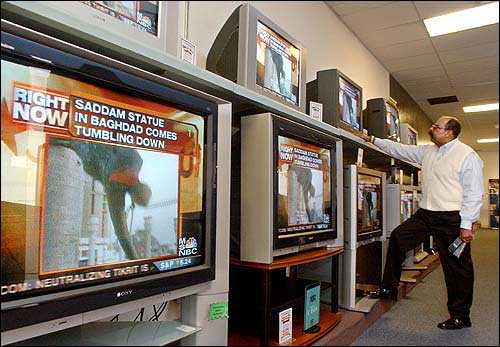
Robert Kendrick, in Anderson's television store in Santa Clara, Calif., watches MSNBC broadcasting video of a Saddam Hussein statue tumbling down in Baghdad, Iraq. Fixated on news coverage of the war in Iraq, shoppers stayed away from stores in March giving the nation's retailers another month of disappointing sales.
Same-store sales are considered the best indicator of a retailer’s health.
Niemira said a big factor depressing March sales was the timing of Easter, which this year falls on April 20, compared to March 31 last year. Niemira estimated the calendar shift lowered sales by about 2 percentage points.
The war’s effect, he believes, depressed sales by no more than 0.5 percentage point, since consumers’ worries about the war have been factored into results during the past few months.
He estimated that April same-store sales, benefiting from the quirk in the calendar, will be up anywhere between 2.5 percent and 3.5 percent.
Niemira and other analysts believe that studying both March and April sales will offer a better measure of the spring season.
Morris expects stores to accelerate price cutting soon to get rid of spring merchandise, putting more pressure on profits.
| Here’s a look at how same-store sales went last month for national retailers with stores in Lawrence. Same-store sales only include stores that have been open at least a year.¢ Abercrombie & Fitch, down 10 percent.¢ American Eagle Outfitters, down 9.3 percent.¢ Gap, up 9 percent.¢ J.C. Penney,down 5.5 percent.¢ Kohl’s, up 0.4 percent.¢ Sears Roebuck, down 3.1 percent.¢ Talbots, up 0.8 percent.¢ Target, down 2.3 percent.¢ Wal-Mart, up 0.7 percent. |