

Avalanche dogs revel in ‘boot camp’
Alta, Utah ? As the helicopter landed, the dogs stared intently at the craft while blinking back the bits of snow propelled through the air.
The pack, mostly Labrador retrievers and German shepherds, waited with their handlers for their turn to hop in for a ride to a staged avalanche slide.
Once there, the dogs searched for and dug out volunteers buried in the snow.
“It’s kind of a boot camp for dogs. They’re out here for four days from 10 a.m. to 4 in the afternoon. They get to do three or four search problems per day,” said Ben Meyerson, a 15-year veteran of the Alta Resort’s ski patrol.
More than 20 teams of highly trained avalanche rescue dogs and their handlers from throughout the West gathered in Little Cottonwood Canyon for four days of training and mock rescue scenarios.
Wasatch Backcountry Rescue was founded in 1976 and is made up of volunteers from nine Utah resorts and helicopter skiing company Wasatch Powderbird Guides. Every two years the rescue group has the seminars.
On the seminar’s third day, handlers exchanged information with colleagues from resorts from Nevada to Canada, while the dogs became acclimated to riding on a snowmobile and jumping into a helicopter while its blades whirl overhead.
Troy Quesnel, from Idaho’s Sun Valley Ski Resort, waited with his 3-year-old chocolate Labrador retriever, Kintla, for her first helicopter ride.
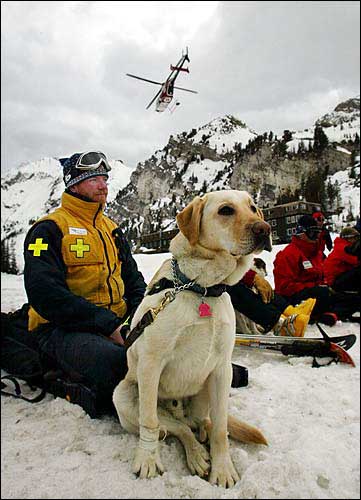
Paul Molnar and his dog Tucker of Copper Mountain Ski Area in Colorado wait with others for a helicopter transport during an avalanche dog training camp in Alta, Utah. Molnar and other ski-patrol personnel from around the West came together to practice avalanche search and rescue techniques.
“It’s extremely helpful to get together will all these other handlers. You learn things you could never get training on with the little groups you have back home,” Quesnel said, looking at his dog. “We’re having a good time at camp.”
Avalanche rescue dogs are usually purebreds: Labrador retrievers, German shepherds, border collies and golden retrievers. They have to be smart and athletic and preferably of a medium size, as those are easier to load into a helicopter or on a snowmobile.
“You can’t have a submissive dog. They have to be a high energy, high-drive dog,” Meyerson said. “We have guys at Alta that come on as secondary handlers, we give them a trained dog and the dogs are so good they basically train the handlers.”
Paul Molnar, a ski patroller with Copper Mountain Ski Resort in Colorado, had his 2-year-old yellow Labrador, Tucker, out on the slopes the second day he got him.
“I was skiing around with him, he was in my jacket with his head sticking out,” Molnar said. “It’s a great life.”
But it’s serious work. If a slide happens and trapped skiers aren’t using avalanche beacons, a search dog is their only hope.
For the most part the dogs don’t know that.
“It is just a game to the dogs. You just want to make things really simple,” Meyerson said. “It’s not much different than playing fetch or getting the paper. What you want to do is make the search game their favorite game.”
But when the search ends in tragedy, Meyerson said, the dogs know it. “Their ears will go down, their tails will go down,” Meyerson said.