

Balance essential to juggling schedules
It’s no secret young people are keeping busy these days with school, sports, private lessons, jobs and an array of other extracurricular activities.
Faced with jam-packed daily routines, some students run the risk of being chronically overscheduled. They can find themselves with too much to do, and too little time to do it.
This doesn’t appear to be an epidemic problem in Lawrence public schools, say those who work with young people, but it’s something that does bear watching.
“It could be an issue. We have a lot of kids who are very scheduled, and I don’t know how much of that is by choice, how much is based on genuine interest in what they’re participating in,” said Phyllis Lewin, a longtime counselor at Southwest Junior High School, 2511 Inverness Drive.
“There probably are some kids who are too scheduled, and there are probably some kids who don’t have enough structure to hook them up with positive kinds of things. I would hope there are enough kids with a sense of balance.”
It’s a good idea for parents to be involved in helping make choices about a child’s schedule of activities. But it’s also good for children to have some say as to how and where they will spend their time.
“If parents are scheduling (activities) without the kid’s involvement, and the kid is saying, ‘I really want to do this,’ or ‘I don’t want to do this,’ I definitely would have a concern with that,” Lewin said.
“There has to be some parental involvement, but if someone has tried an activity for awhile and says, ‘It’s not my thing,’ you have to respect that.”
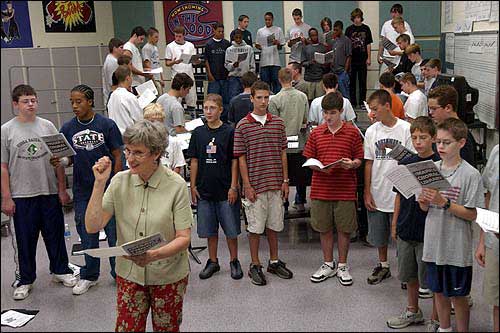
Janeal Krehbiel, leads members of the Southwest Junior High School Bel Canto Choir. The choir was rehearsing Wednesday at the school. Choir is just one of many activities offered at the school.
Research studies seem to show that there’s a real upside for students who do participate in school-related pursuits such as team sports or clubs.
“Kids who are involved in some extracurricular activities typically feel more connected to school, and usually there is a positive correlation to achievement,” Lewin said.
“If you have a kid who has found an activity that’s really important to him or her, and they want to be involved, that makes school more important in that child’s life.”
Brian Anderson sees plenty of students who stay busy with sports and other after-school activities. He teaches math and coaches wrestling at Central Junior High School, 1400 Mass. Anderson also coaches cross country and track at Lawrence High School, 1901 La.
Participating in lots of activities can lead to scheduling conflicts, such as an evening when soccer practice coincides with a track meet. Or when a sporting event keeps a student out especially late.
“The times when it gets kind of rough is when they’ll play a softball or baseball game, and they might not get done until 11 or 12 at night. They’ve been there since right after school, they didn’t get their homework done and the next day when they get to class, all they want to do is sleep,” Anderson said.
That’s not so much an example of overscheduling as it is a case of needing to realize how much time an activity requires.
“It would be really good if they could keep a balance, and it’s not just in athletics there’s a wide variety of activities that are available,” he said. “It’s nice to have that many options, but students can sometimes get lost as to where to go.”