

Provisional Palestinian state plotted
United Nations ? The United States and its key global partners in Middle East peacemaking agreed Tuesday to try to establish a provisional Palestinian state next year.
U.N. Secretary-General Kofi Annan cautioned that in proposing a “road map” to settlement of more than a half-century of conflict between Israel and its Arab neighbors, the leaders based their goal on hope as well as security and other steps still not taken.
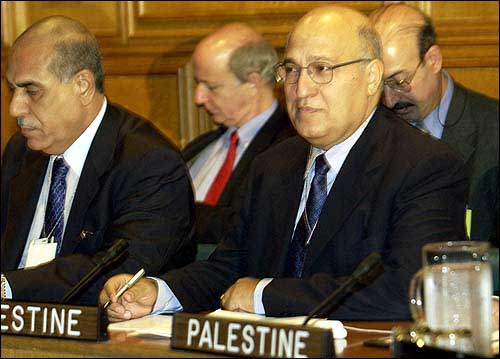
Palestinian Planning Minister Nabil Shaath, right, sits with other members of his delegaton as they prepare for a meeting on Palestinian statehood. A plan offered Tuesday calls for statehood by 2005.
Still, Annan called the meeting historic. “We intend to be steadfast” in seeing the plan through, he said.
Secretary of State Colin Powell, Russian Foreign Minister Igor Ivanov, Foreign Minister Per Stig Moeller of Denmark and other European Union leaders joined Annan in a conference room in the basement of U.N. headquarters.
The communique they issued did little to clarify what an eventual provisional Palestinian state would entail except that it would have temporary borders and be a way station to a permanent state.
The communique was the first major political document by the Quartet, an ad hoc enterprise of the European Union, Russia, the United Nations and the United States to bring an end to the Middle East impasse. The Quartet’s expanding role reflects a sharing by the Bush administration of what for three decades has been a virtual U.S. monopoly on peacemaking efforts.
The plan outlined in the communique has three phases, with the aim of a final settlement between Israel and the Palestinians by 2005.
It specifies that Israel should end its 35-year occupation of the West Bank and Gaza but does not say whether Israel should give up all land the Arabs lost in the 1967 Six Day War. Nor was there a direct reference to Jerusalem, part of which Palestinian leader Yasser Arafat expects for a capital.
The document also deplored and condemned “the morally repugnant violence and terror” that gripped the area until recently and said it must end.
A principal Arafat deputy, Nabil Shaath, represented the Palestinians at the conference. Bush met with Shaath last week at the United Nations.
Saudi Arabia, Egypt, Syria, Jordan and Lebanon also had ministers at Tuesday’s meeting.
To prepare for a state, the Quartet suggested the Palestinians adopt a constitution with provisions to stop corruption and to provide “the vibrant political system which Palestinians deserve.”
Early next year, in the first phase of the plan, the Palestinians would have “fair and credible” elections that Israel was urged to facilitate by withdrawing its military forces from Palestinian-controlled areas.
Powell said the Quartet would work out ways “where the people are able to get back and forth to participate in such an election process.”
Israel’s occupation would end in the plan’s third phase through a settlement negotiated between Israel and the Palestinians.
The Oslo agreement of 1993 called for Israel to withdraw in stages. While the agreement was never completed, Israel had pulled back to the extent that the vast majority of Palestinians were in areas wholly or partially administered by Arafat’s Palestinian Authority. But in September 2000, responding to a Palestinian uprising, Israel partially reversed course.