

Saddam takes pains to avoid killers
Baghdad, Iraq ? His hat? Kevlar-coated for bulletproofing. His meals? Nibbled by food-tasters first, sampling for poison. And is it really Saddam Hussein anyway or one of his many reported doubles, hired to fool would-be assassins?
Contemplating war, Washington has made clear that this time it’s personal: The U.S. goal in any attack on Iraq would be getting rid of its leader.
But Saddam is taking elaborate steps against being eliminated ranging from networks of bunkers, sleeping compartments on wheels, to unusual headgear according to those who’ve dealt with him and Western intelligence agencies.
Unseen among his people since December 2000, the Iraqi leader today appears only on television in very secure settings. An armed guard stood next to him during a televised appearance last week before Parliament.
“This talk of changing regimes, this is a dream. If they want to talk about a bullet or anything else, it’s just a dream,” crowed Parliament member Mohammed Mudhafr al-Adhamy, referring to intermittent U.S. talk of assassination.
Americans have “been trying and trying for 30 years, and they couldn’t do anything. They tried in 1991, and they couldn’t do anything,” said al-Adhamy.
President Bush’s administration has been outspoken in its aim of ridding Iraq of Saddam, at a U.S.-estimated price of $9 billion a month for war or less.
“The cost of one bullet, if the Iraqi people take it on themselves, is substantially less than that,” White House spokesman Ari Fleischer said early this month, drawing some heat for the direct call for an assassination.
Take a number
But countless others before the Bush administration have wanted Saddam gone official biographies list at least nine assassination and coup attempts against him.
Iraq’s wily leader has survived them all, and learned lessons.
“You will have to wait in line to get to me. Thousands are ahead of you wanting to kill Saddam Hussein,” he is said to have told an Iraqi tribal leader decades ago, talking the desert sheik out of launching a bloody vendetta over a killing blamed on Saddam’s family.
Saddam himself has been on both ends of an assassin’s gun. In 1959, the 22-year-old Saddam took part in a botched attempt to kill then-military ruler Gen. Abdel Karim Kassem as he drove down Baghdad’s main thoroughfare, Al Rashid Street.
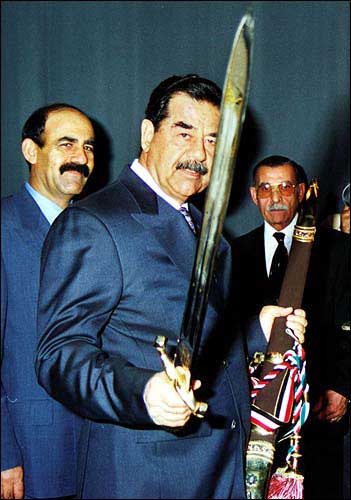
Iraqi President Saddam Hussein shows a sword given to him as a gift before being sworn in as president in Baghdad. Saddam on Thursday swore himself in for another seven years in power. He is rarely seen in public these days, and goes to great lengths to protect his life.
Saddam and his accomplices fired wildly. Kassem was shot in the shoulder but survived. Saddam, too, was wounded.
He has cited that mishap ever after as a life lesson in organization and planning.
Always on the move
Now, heading into possible conflict with the United States, Saddam has made his whereabouts a mystery to his own people.
Saddam did not go out in public during last week’s referendum vote that extended his military rule for seven years.
Only his eldest son Odai made a fleeting appearance in the flesh. At a polling station in front of reporters, he drove up in a luxury car, handed a ballot out the window for a 6-year-old stranger to cast for him, and then sped off.
Odai himself barely survived an assassination attempt in December 1996.
Ever since, the Saddam family has avoided motorcades, even well-guarded ones relying instead on the anonymity of unmarked cars as they dart among dozens of palaces and family homes.
Said Aburish, a Palestinian who worked as a lobbyist for the Iraqi government with the West in the 1980s, an Iraqi ex-intelligence chief, and others in exile have detailed how far Saddam goes to safeguard himself.
Meals are prepared in each of his palaces, to conceal until the last minute where the Iraqi leader will be dining.
Food-tasters sample the dishes.
Visitors to the president are driven about for disorienting hours before arriving at meetings, at mystery locations.
Several Saddam doubles were reported in the 1980s and 1990s filling in for the real Saddam during lesser events, and sometimes, reportedly drawing assassin’s fire.
The real Saddam, in his last appearances before his people, dressed in the manner of an English country gentleman to review his troops wearing a wide-brimmed fedora unusual for Arab leaders. Kevlar-coated, Aburish says.
In the Gulf War, Saddam Hussein rode out the American-led attacks in undisclosed homes of average citizens in Baghdad for many nights shunning his own palaces, more visible targets, personal secretary Lt. Gen. Abed Hammeed Mahmoud later wrote.
This time around, many suspect Saddam would hide in Baghdad or in his home turf around the northern city of Tikrit.