

U.N. weapons inspectors ask Iraq to confirm outline of agreements
United Nations ? U.N. chief weapons inspector Hans Blix said Wednesday he still hoped to send an advance team to Iraq by the end of October to prepare for a resumption of inspections.
The Security Council is discussing a possible new mandate for inspectors and Blix said it was reasonable to wait “at least for some little time” for the 15 council members to make a decision before sending the advance team.
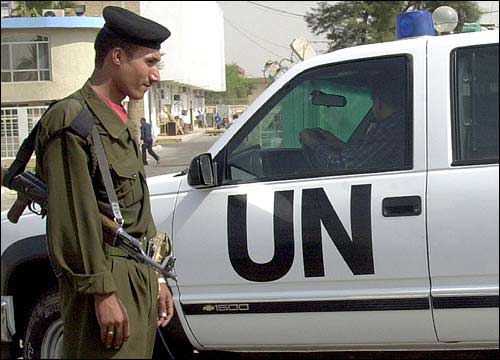
A United Nations car passes an Iraqi guard at the entrance of U.N. headquarters in Baghdad, Iraq. U.N. weapons inspectors hope to return before the end of the month, and are asking for Iraqi assurances on details of their inspections.
In an interview on PBS’ “NewsHour with Jim Lehrer,” Blix said a timeline originally called for inspectors to be in Iraq by the middle of October.
Because of the possible change by the Security Council, “we think that it will be reasonable to wait for that mandate, at least for some little time, so still hopefully before the end of October,” Blix said.
Seeking to ensure Iraq’s cooperation, U.N. weapons inspectors have sent the Iraqi government a letter outlining agreements reached earlier this month in Vienna on the resumption of inspections.
The letter, circulated to Security Council members on Wednesday, asks Iraq to confirm its acceptance of agreements on a host of issues including that it “clarified” during the Vienna talks that inspectors “will be granted immediate, unconditional and unrestricted access to sites, including what was termed ‘sensitive sites’ in the past.”
Those sites include the Ministry of Defense and facilities of Saddam Hussein’s Republican Guards, which were previously off-limits to surprise inspections.
The letter noted that a 1998 agreement between Iraq and the United Nations requires advance notice to inspect eight presidential sites, but raised the possibility that this might change.
“Should these sites be subject, as all other sites, to immediate, unconditional and unrestricted access,” it said, inspections would be conducted there “with the same professionalism.”
The United States is demanding that the 1998 exemption be lifted and that all presidential sites encompassing 12 square miles also be subject to surprise inspections.
Iraq says it has nothing to hide at the sites, but considers them a symbol of their sovereignty and wants the agreement, which was endorsed by the Security Council, to remain in effect.
The letter was signed by Blix, who is in charge of dismantling any chemical and biological weapons and long-range missiles that Iraq possess, and Mohamed ElBaradei, director-general of the International Atomic Energy Agency, which is responsible for dismantling any Iraqi nuclear weapons.
It was sent to Gen. Amir Al-Saadi, an adviser to President Saddam Hussein who headed the Iraqi delegation at the Vienna talks.
In the letter, dated Tuesday, Blix and ElBaradei said they were putting the agreements in writing and asking for confirmation at the request of Security Council members.
The letter also asks Iraq to confirm that no relevant material will be destroyed except in the presence of inspectors, that inspectors can interview any Iraqi they believe “may have information relevant to their mandate” wherever they want, and that inspectors can use helicopters “without limitation in all parts of Iraq and without any area excluded.”
The letter also details arrangements for offices, Iraqi escorts, communications, ground transport, security and visas.