

Dockworkers begin to tackle 10-day backlog of cargo
Los Angeles ? West Coast dockworkers returned to their jobs under court order Wednesday and were greeted with a huge backlog of cargo that built up over 10 days of a labor lockout.
“It’s been very hard. We’re just glad to be back at work,” said Karen Korbich, a dockworker for the past nine years. “We expect it to be very congested.”
Dockworkers at the Ports of Los Angeles and Long Beach held a rally before returning to their jobs. They were joined by civil rights activist Jesse Jackson, who helped lead cheers of “We want to work!”
The cargo backlog caused by the lockout could take more than two months to clear.
“Simply put, it’s more complicated to fix something than to break it,” said John Pachtner, a spokesman for the Pacific Maritime Assn., which represents shipping companies and terminal operators.
The 10,500 members of the International Longshore and Warehouse Union reported at hiring halls to work 6 p.m. shifts, ending a lockout that shut down 29 ports from San Diego to Seattle and cost the nation’s fragile economy up to $2 billion a day by holding up exports and imports.
Dockworkers were expected to labor around the clock, with other shifts beginning at 3 a.m. and 8 a.m., officials said.
President Bush intervened Tuesday, obtaining an injunction to end the shutdown.
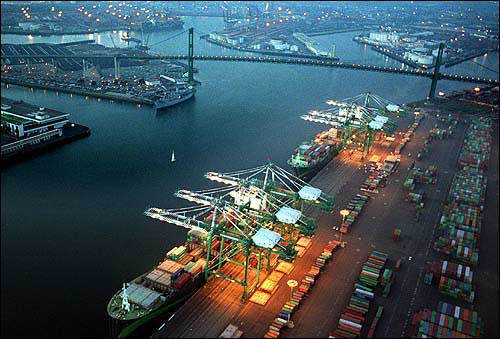
Cranes are lowered over container ships at the Evergreen Container Terminal at the Port of Los Angeles. Ships were unloaded Wednesday for the first time in 10 days due to the West Coast port lockout.
Among the first cargo to be shipped will be perishables like seafood, meat and produce in refrigerated containers aboard some of the more than 200 ships anchored off the coast. After that, shipping companies will set their own priorities based on their customers’ needs and demand for cargo.
The critical challenges will be lining up transportation on trucks, trains and planes, and finding enough longshoremen for the expected round-the-clock work, Pachtner said.
“We need the ILWU to provide as many able-bodied people as possible who are fully productive,” he said. “That’s what will unclog the pipeline as soon as possible.”
The lockout began after the maritime association accused union members of an illegal slowdown during contract talks. The dispute centers on the use of new waterfront technology that the union believes would eliminate jobs.
On Tuesday, Bush became the first president in a quarter-century to invoke the Taft-Hartley Act of 1947, which allows a president to ask a federal court to stop a strike or lockout that imperils the nation’s health and safety. A federal judge in San Francisco issued the injunction.
“The union is very happy to be returning to work today, but we are not happy with the presidential orders,” said Ramon Ponce De Leon Jr., president of ILWU, Local 13, in Los Angeles.
He said that workers are “frustrated and disappointed.”
“We were not forced back to work the employers were forced to place work orders in our hall,” said Ponce De Leon, who cautioned that there would be gridlock on the docks for the next few weeks.
Union Pacific, the nation’s largest railroad, sent extra cars to West Coast ports and opened a 24-hour “war room” in its dispatch center to give priority to eastbound shipments.
Manufacturers hoped to get parts in time to avoid layoffs and shutdowns.
“As soon as the (port) gates open, we think we can resume truck production by Friday morning,” said Michael Damer, a spokesman for New United Motor Manufacturing in Fremont.
Some truckers said they would wait until the docks were working again before deciding how to proceed. “A lot of drivers aren’t going to go because it will be backed up,” said Stephanie Williams of the California Trucking Assn.
The truckers are a key link in the transportation chain because they haul cargo between the waterfront and inland storage points.